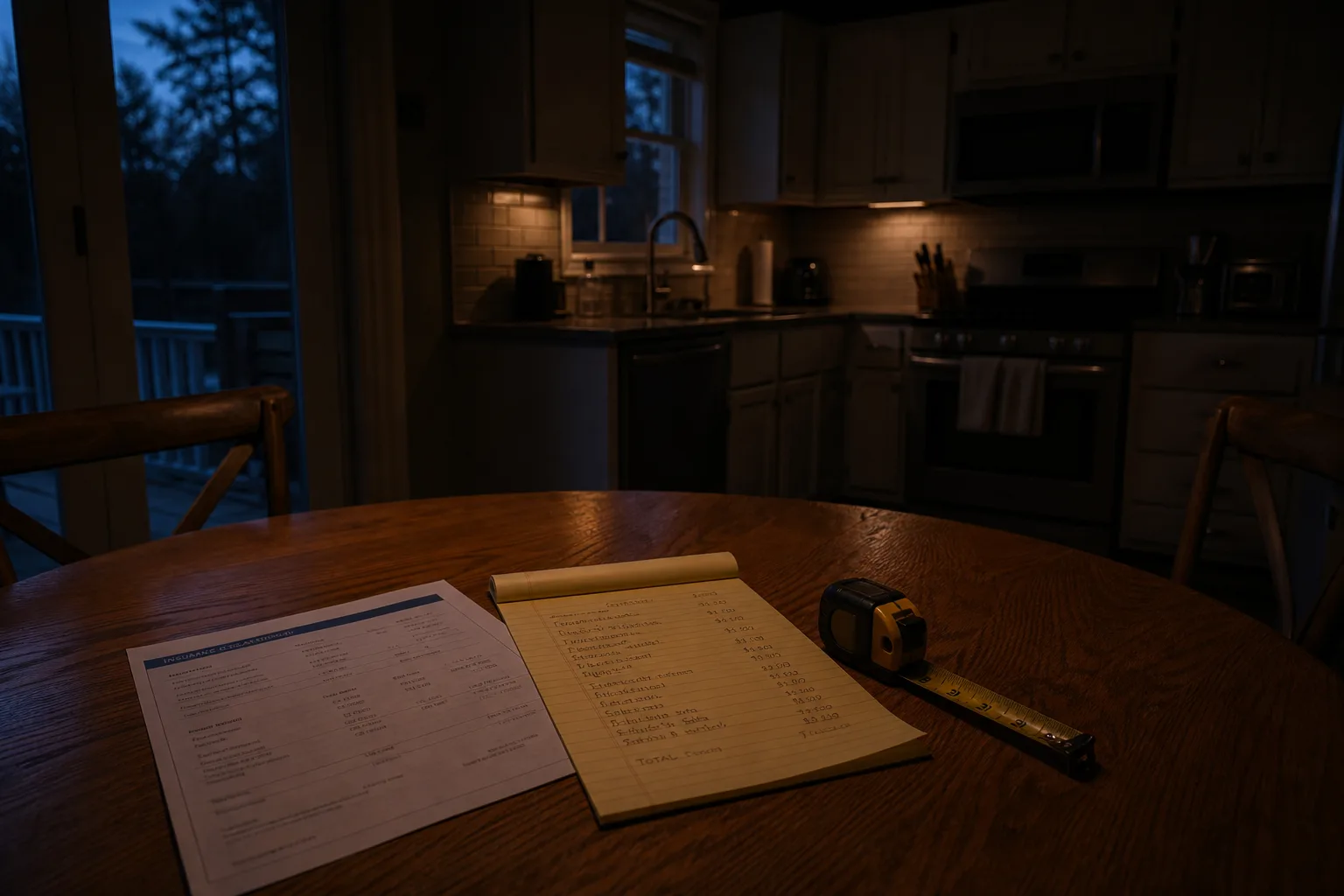
The dwelling limit on a homeowners policy gets chosen in the least deliberate part of the transaction, usually in a phone call somewhere between the inspection and the closing date, when the buyer is answering thirty questions and has opinions about none of them. Someone types a square footage, picks a construction class, and a piece of software returns a number. That number then sits on the declarations page for years, adjusted upward by a small inflation factor each renewal, until a pipe fails or a kitchen burns and the number is measured against what rebuilding actually costs. The gap between those two figures is where a first claim goes wrong.
The clause that measures your limit against the real cost
Most homeowners policies contain a provision requiring the dwelling limit to equal some stated share of full reconstruction cost, commonly expressed as eighty percent. Meet it and partial losses are settled on their own merits, subject to the deductible. Miss it and the carrier applies a proportion: the ratio of what you carried to what you should have carried, multiplied against the loss. Insure at half of what rebuilding costs and a partial claim is reduced accordingly, even though the loss itself is nowhere near the policy limit. This is the averaging trap, and it is the one penalty in property insurance that punishes you hardest on the small and medium claims you are statistically most likely to file.
The mechanic that surprises people is that the test runs at the time of loss, not at the time of purchase. A limit that was accurate on the day the policy was written can fall out of compliance three years later because materials, labor and code requirements moved and the annual inflation adjustment did not move with them. Nobody sends a letter about it. The declarations page arrives every twelve months looking almost identical to the last one, with a slightly larger dwelling figure, and it is entirely possible to read it carefully every year and still be under-insured by a quarter.
Who set the number, and who they work for
Follow the chain and the picture gets clearer. If you bought through a captive agent, that person is an appointed representative of one carrier and used that carrier's estimating tool. If you bought through an independent agent, they placed you with one of several carriers and used whatever valuation platform that carrier requires. If you bought online, no human touched the estimate at all. In every version, the reconstruction figure came out of a licensed third-party estimator fed by whatever data was entered, and the quality of the output is decided almost entirely by the quality and quantity of what went in.
That matters because the person entering the data is not paid to spend forty minutes on it. A quick valuation takes square footage from public records, assumes an average grade of finish, assumes standard foundation and roof, and produces something defensible. A thorough one asks about the actual counter material, the plaster versus drywall question, the number of interior corners, whether the roof has multiple planes and valleys, whether the house is on a slope, whether there is a finished basement, whether anything about access would make a rebuild slower. The tool is the same in both cases. The answers are not, and the spread between a fast entry and a careful one on the same house is not small.
What a careful valuation actually involves
The good version of this job has a rhythm to it. It starts with a conversation of twenty to forty minutes covering interior finishes room by room, not house-wide averages. It asks for the age of the electrical service, the plumbing material, and the heating system, because those drive code upgrade exposure during a rebuild. It accounts for ordinance and law coverage separately, since bringing an older house up to current code after a major loss is a real cost that the base dwelling limit does not always absorb. For a house that is unusual in any respect (historic, custom, heavily renovated, built on difficult ground), the careful version says plainly that the software is out of its depth and recommends a paid replacement cost appraisal from an independent estimator or a general contractor, which typically runs a site visit plus a week or two of turnaround.
The barely adequate version skips all of that and lands on a number that is roughly right for a house of that size in that zip code. It is not fraud and it is not negligence in any actionable sense. It is a default, and defaults are set for volume. The distinction a first-time buyer needs is that nobody in the chain has a duty to keep your limit accurate over time, and the software's annual bump is an index, not a measurement. The Federal Emergency Management Agency is responsible for the federal flood program, which is a separate policy with its own limits entirely, and assuming your homeowners dwelling limit covers rising water is the second most common gap after the first one.
Fixing it, and how long each step takes
Correcting a low limit does not require waiting for renewal. An endorsement raising Coverage A can usually be requested by phone or portal and issued within a few business days, with the additional premium prorated to the remaining term, and the change is effective from the date the carrier writes it rather than the date you asked. Getting an independent reconstruction estimate first adds one to three weeks: a scheduling window, a site visit of an hour or two, then the write-up. If the increase is substantial, some carriers order their own inspection, which adds two to four weeks and occasionally produces recommendations of its own about the roof or the electrical panel. None of that waiting is dead time so long as the endorsement is in force before the loss, and the practical move is to start the estimate in a quiet month rather than in the week after a storm, when every estimator within fifty miles is booked.
The number to hold onto is not the market value of the house and not the mortgage balance. It is what a contractor would charge to rebuild it, at today's labor rates, to today's code, on that lot. Ask who produced that figure, when, and from what inputs. If the answer is a square footage and a zip code, there is a better version of the job available, and it takes about an afternoon to set in motion.