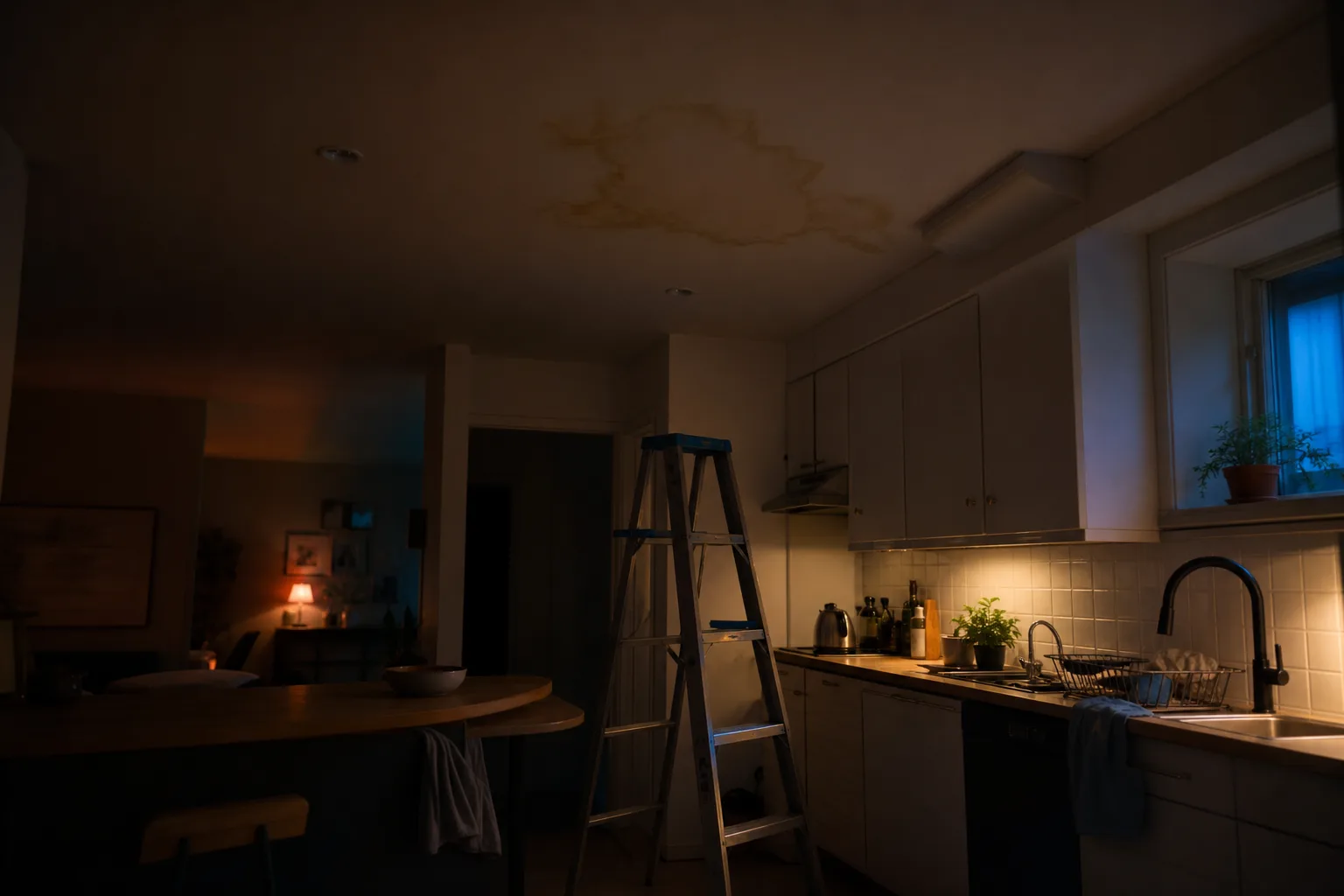
The stain showed up in September, four months after closing, a soft brown oval on the kitchen ceiling directly beneath the upstairs bathroom. It was not dripping. It was not growing while anyone watched. The homeowner, who had never filed a claim on anything larger than a windshield, did what most people do first, which was to open the policy declarations page, find the deductible, and then sit with the question of whether a call to the carrier was a question or a claim. That distinction turned out to be the whole story, and it took her ten days to understand it.
The ten days before anyone filed anything
A plumber came on day three, pulled the access panel behind the tub, and found the shower pan liner failing at one corner, a slow release rather than a burst. His written estimate covered the pan rebuild, the tile work, and the drywall patch below, and the total landed at roughly twice her deductible. That ratio is where most first-year homeowners stall, because the arithmetic looks like a small win and the consequence sits somewhere off the page. She asked the plumber what other clients did. He said half of them file and half of them pay, and the ones who pay tend to be the ones who have filed before.
How a question became a record
Her agent gave her the answer that matters: in many carriers' systems, a phone call describing a loss can be logged even if no payment is ever requested, and that log can surface later as an inquiry or a closed-without-payment entry. The reason this exists at all is administrative history rather than malice. Insurers built shared loss databases decades ago so that a claim reported to one company would be visible to the next, which cut down on duplicate recoveries and gave underwriters something more reliable than an application checkbox. Those databases are operated by consumer reporting agencies, which places them under the same federal consumer reporting framework the Federal Trade Commission is responsible for enforcing. You have the right to see your own file, and to dispute what is in it.
What the file says, and how long it says it
She requested her property's loss history report before deciding anything, which is a step almost nobody takes in year one and probably should. It arrived within a couple of weeks, free, and it showed something she had not known: a prior water loss at the address, paid, from before her purchase. That is the part first-year homeowners rarely anticipate. Loss history attaches to the property as well as to the person, so the seller's claim from a burst supply line in a previous winter was already sitting in the file she was about to add to. Entries typically stay visible for around five to seven years depending on the reporting agency and the state, which means her decision was not about one claim but about how a second entry would read next to a first.
Coding mattered as much as the count. A claim recorded as water damage from plumbing reads differently to an underwriter than one recorded as mold, and different again from one recorded as maintenance-related seepage, which some policies exclude outright when the leak has been ongoing. She asked the adjuster, when he eventually came, what category the file would carry. He told her, and he told her the number was provisional until the file closed. Asking that question early costs nothing and occasionally changes the answer, because a coding error caught in week two is a correction and the same error caught in year three is a dispute.
The renewal calendar, which is slower than people expect
She filed. The adjuster's inspection came about a week after the first notice, the estimate was agreed roughly three weeks after that, and the first payment issued near the end of the second month, with the holdback released after the tile work passed. The entry appeared in the loss database within a month or two of the file closing. Her renewal was not due for another seven months, which is the crucial piece of timing most people miss: nothing happens to your premium the week you file. Carriers reprice at renewal, using the loss history current at the point the renewal is prepared, which is generally somewhere between sixty and ninety days before the policy period ends. Notice of any change, including nonrenewal, has to reach you within a window your state sets, frequently thirty to sixty days out.
What she did with that runway is the useful part. She kept the plumber's invoice, the adjuster's final scope, and photographs of the finished pan, and when the renewal offer arrived with a modest increase, she sent that packet to her agent with a short note explaining that the cause had been repaired rather than patched. It did not erase the entry. It did give the underwriter a reason to treat one water claim as a closed condition rather than an open pattern, and she was quoted competitively when she shopped the policy the following spring.
The lesson she took into year two was procedural rather than moral. Pull the loss history report on your own address early, before anything happens, so you know what you inherited. Ask how a loss will be coded before the file closes. Then count backward from your renewal date, because that is the only deadline in the process that anyone else is watching.