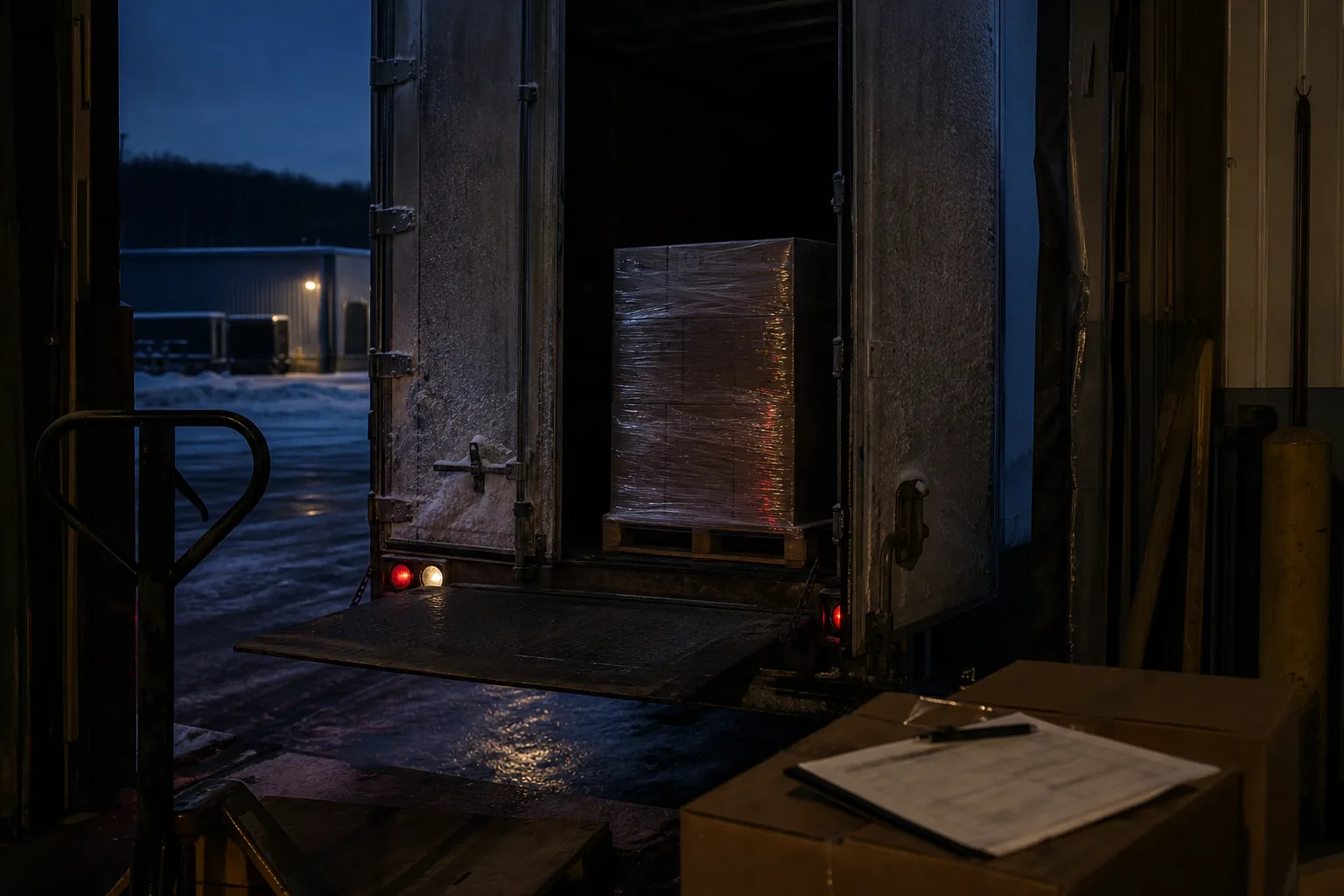
The carton that arrives crushed in February usually left the shipper square and intact. Something happened in between, and the something is rarely the dramatic drop people imagine when they open the box. It is more often forty hours in an unheated cross-dock, a trailer loaded to the roof because the week before Christmas leaves no empty space, and a handler on his ninth day of overtime moving a pallet he would have moved differently in April. When you are three states away and reading about it in an email, the cause looks like carelessness. The cause is usually the calendar.
Anyone who has shipped through four or five annual cycles stops arguing about fault and starts arranging the paperwork so that fault matters less. That is the shift worth copying.
Cold makes packaging brittle and heat makes it soft
Corrugated board holds its rated stacking strength in a narrow band of temperature and humidity, and loses a meaningful share of it once the air in a trailer goes damp, which it does every time a cold load is opened into a warm dock. Pressure-sensitive tape stops bonding below roughly freezing and begins to creep above about ninety degrees, so the same seam that held in October pops in January and peels in July. Shrink wrap on a pallet goes stiff and cracks in the cold rather than stretching. Foam inserts stiffen too, which sounds protective and is not, because a rigid insert transmits shock instead of absorbing it.
The practical consequence is that identical packing performs differently in different months, and the failure shows up as something that looks like handling damage. A veneer panel that delaminates, a sealed jar that weeps, a finished table leg that arrives with a hairline split along the grain: those are humidity and temperature events, and they take days to develop, not seconds. If your product line runs through adhesives, laminates, liquids or anything with a cure, the winter version of the carton and the summer version of the carton should not be the same carton.
Peak weeks add handlers, and every handler is another chance to be dropped
A shipment that moves point to point in May often moves through two extra terminals in November, because peak volume forces consolidation, and consolidation means your pallet gets broken down, restacked under somebody else's freight, and rebuilt. Each transfer is a lift, a set-down and a few minutes on a dock floor. Dwell time stretches as well. A load that normally sits six hours in a yard can sit through a weekend when the terminal is full, and that weekend is where the temperature swing does its work.
Seasonal staffing compounds it. The people working the dock in the last six weeks of the year include a substantial share who were hired for those six weeks, trained quickly, and are being measured on throughput. The Federal Motor Carrier Safety Administration oversees interstate motor carriers and the terms under which household goods and commercial freight move, and the carriers themselves know exactly where their seasonal exposure sits. What they do not do is call you to say your delivery window has slipped by four days. You find that out by tracking it yourself, or by not finding it out at all until a tenant calls.
The claim clock starts at delivery, not when you finally open the box
Standard bill of lading terms on interstate freight give you a long outer window to file a written claim, commonly nine months, and a longer one to sue, commonly two years and a day. Those numbers are generous and misleading. The window that actually decides the outcome is much shorter: the notation on the delivery receipt at the moment the driver is still standing there, and the concealed damage notice, which many carriers hold to a handful of days after delivery and some hold to five. Miss the second one and the long nine-month window is an empty corridor leading to a locked door.
This is where the absent owner loses money without ever touching the freight. Somebody at the receiving end signs clean, because signing clean is what people do, and the clean signature is the carrier's evidence that the goods arrived in apparent good order. From that point you are arguing against your own paperwork. The fix costs nothing and takes one phone call before the truck arrives: whoever signs writes the exception on the receipt, counts the pieces, and photographs the pallet while it is still on the liftgate.
Set up the receiving before you set up the shipping
If you are managing a property or a job from another city, assume you will not be there, and then build the receiving around that fact rather than hoping the schedule cooperates. Name one person at the destination who has written authority to refuse a damaged pallet, and tell them in plain language what refusing looks like, because most people will not refuse delivery on their own initiative. Give them a short instruction: count, photograph, note anything crushed, torn, wet or leaning, and do not sign the word clear. Then schedule your own inspection within forty-eight hours of delivery, and do it even when the outside of the box looks fine.
Decide the valuation before the shipment moves, not afterward. Household goods carriers default to released value, a flat rate per pound per article that will not replace anything you care about, and full value protection costs more and has to be elected in advance. Commercial freight classes carry their own liability limits by class and by commodity. Reading those limits in December, after a claim, is how people learn that the carrier's maximum exposure on a damaged item was a fraction of its replacement cost. Reading them in September costs an hour.
What the season should change in your booking
Move the date if the date can move. Shipping the week before a holiday peak rather than inside it typically buys you fewer transfers, shorter dwell and a driver who is not on his third consecutive long day. Build the transit estimate with slack, because quoted transit times in peak months are a plan rather than a promise, and a two-day cushion absorbs most of what goes wrong. Specify climate protection where the freight genuinely needs it and accept that it costs more. Upgrade the packaging seasonally, with heavier board and cold-rated tape through winter, and more void fill through humid months.
The owners who come out of peak season without losses are not luckier. They booked earlier, packed for the month rather than the product, and put a named person at the receiving door with a camera and permission to say no. Everything in that list is arranged by phone in advance. None of it can be arranged afterward.