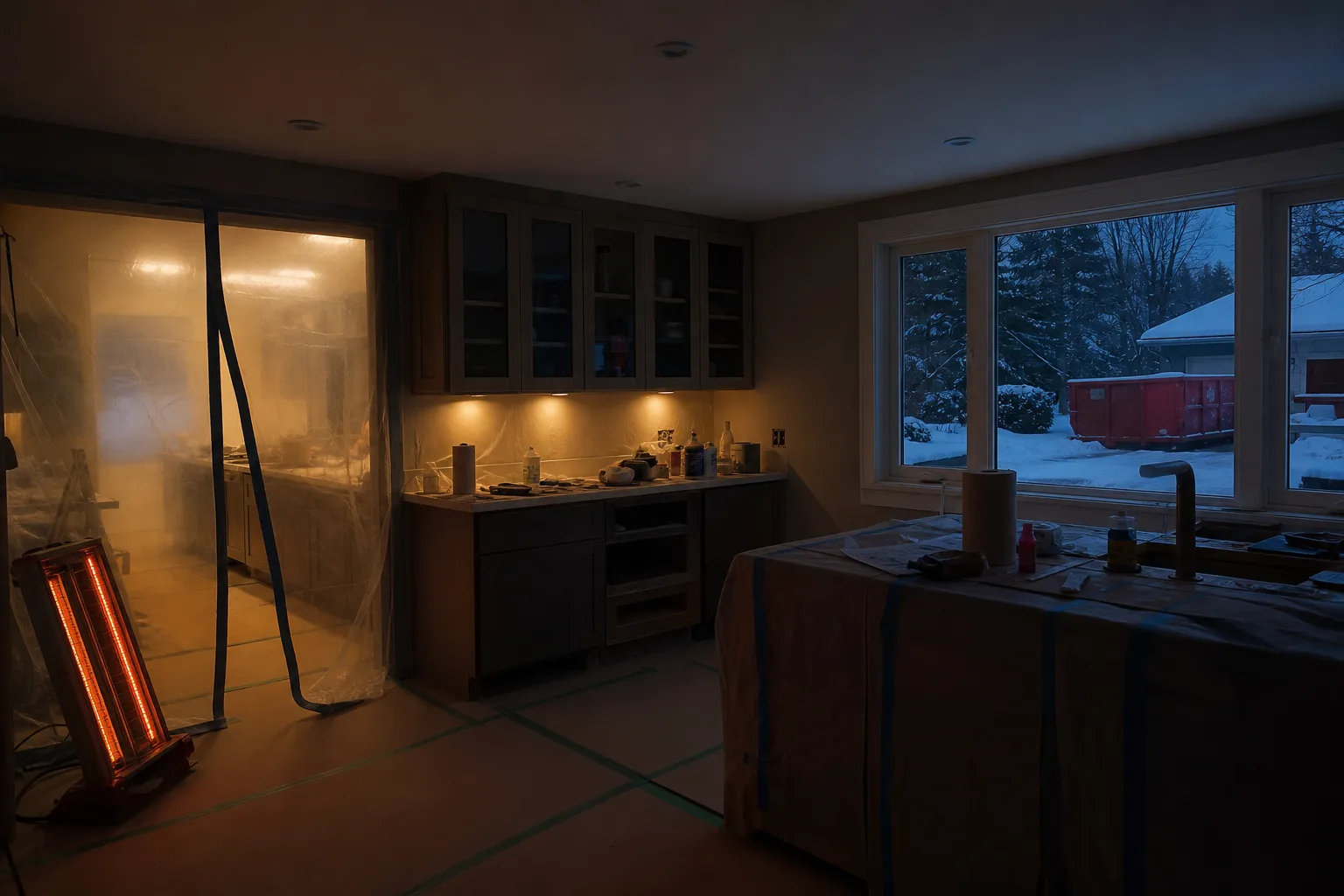
The scope of work you sign in late October is a different document from the one you would sign in May, even if the contractor hands you the same template with a new date typed at the top. Cold changes what materials will do, how long a crew can stand outside, when the light goes, and how many days in a row anyone can realistically show up. None of that is exotic. It is just the ordinary weather, applied to a job that was priced as though weather were an abstraction, and the places it surfaces are small, domestic, and cumulative.
Who gets to call a weather day, and what happens to the calendar when they do
Almost every residential contract says the schedule may extend for weather. Almost none of them say who decides, on what basis, or by when you will be told. That vagueness is harmless in June and expensive in January, because the practical question is not whether a lost day is legitimate but whether you learn about it at seven in the morning or at ten past nine, after you have already moved a meeting and let the dog out early. A good scope names a threshold, something checkable like sustained precipitation or a temperature below a stated figure, and it names a notification time.
The second half matters more than people expect. A day lost to weather should roll the finish date by one working day, not by a week, and the scope should say so plainly, because the gap between a crew losing Tuesday and a crew losing Tuesday and then picking up again the following Monday is four days of your life with the kitchen in the garage. Ask for the makeup rule in writing. It is one sentence. It is also the single clause that most often separates a January job that ends in January from one that ends in March.
The temperature minimums are printed on the product, not in the quote
Paint, joint compound, exterior caulk, mortar, asphalt products, self-leveling underlayment, and most adhesives all carry an application temperature range from the manufacturer, and several of them specify not just the air but the surface and a minimum hold for some hours afterward. A crew working to a deadline will sometimes apply at the edge of that range and the result does not fail that week. It fails in April, as adhesion loss, as a cold joint, as a seam that telegraphs through the finish once the house warms up and everything moves. By then the invoice is paid and the conversation is harder.
The fix is a line in the scope committing the contractor to manufacturer-specified conditions, with temporary heat or a cure delay as the named alternative rather than an improvisation. If temporary heat is in play, the scope should say who supplies it, who pays for the fuel or the electricity, and whether it runs overnight, since an unattended heater in an unfinished space is a decision somebody should make deliberately. The Occupational Safety and Health Administration is responsible for workplace conditions including cold exposure and the ventilation of heated enclosures, which is worth knowing when a crew proposes to seal a room and run propane inside it.
Your house keeps being a house while this happens
Here is where the week-to-week reality lives. A door propped open for a hose or a cord in December is not a scheduling detail, it is your furnace running continuously and a utility bill that arrives three weeks later with no explanation attached. Windows cannot be opened for dust, so containment has to be physical: zippered barriers, negative air, taped registers, and a stated rule about which rooms stay sealed overnight. A scope that specifies daily cleanup and a sealed boundary is also specifying whether you can cook, whether the baby sleeps, and whether you spend Saturday wiping drywall dust off everything you own.
Winter light compresses the day. A crew that arrives at eight and loses usable exterior light by half past four is working a shorter shift than the estimate assumed, and the honest version of that is written into the hours, not discovered in week three. Ask for expected arrival and departure times, whether work happens on Saturdays, and what the crew does with the house at the end of each day: locked, heat restored, plastic resealed, driveway passable. Those four conditions, written down, are what turn a construction week into a livable one.
The driveway, the dumpster, and the week the trash does not get collected
Snow turns site access into a negotiation nobody budgeted. A dumpster set in the driveway in November may be frozen in place by January, and if the town plows to the curb, the pile ends up exactly where the crew needs to walk. The scope should assign snow clearing for the work path and the material staging area, name where deliveries go when the yard is unusable, and say who shovels around the dumpster so your own trash and recycling still reach the street on collection day. Parking belongs in the same paragraph, especially on a street with a winter overnight ban.
Material storage deserves its own line. Lumber, cabinetry, flooring, and finished millwork all want conditioned space before installation, and acclimation periods are real time on the calendar, usually measured in days, sometimes longer for wide-plank wood. If the scope says delivery and installation in the same week without saying where the material sits and at what temperature, somebody is going to install cold flooring into a warm house and the gaps will show up by spring.
Add the holiday weeks before you sign. Ask which days the crew is off between Thanksgiving and the first full week of January, ask whether the subs follow the same calendar, and have those dates written into the schedule as planned closures rather than discovered absences. A December job with eight named days off and a clear makeup rule finishes closer to its date than a December job that promised not to stop.