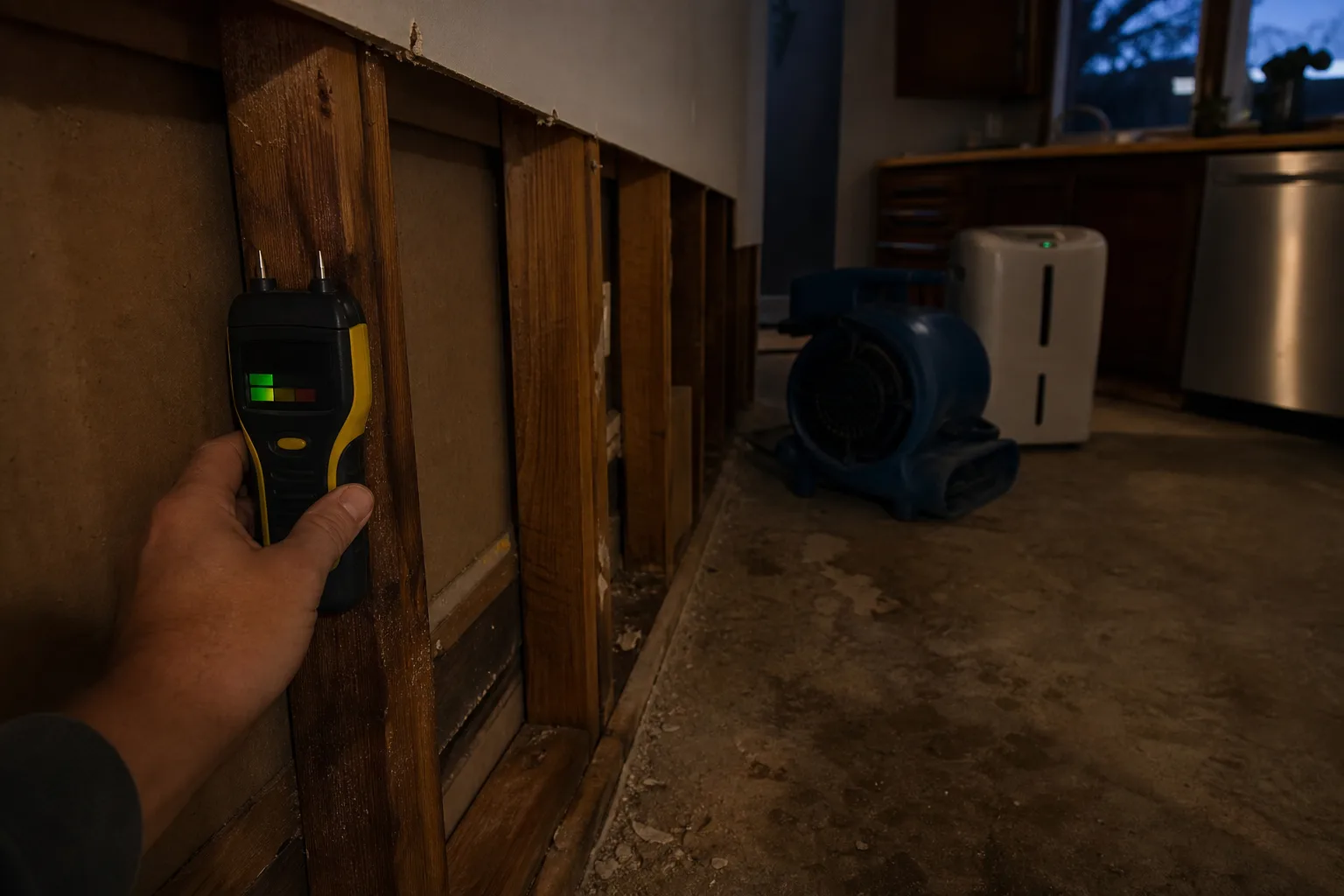
The first winter in a house teaches you which noises matter, and a supply line letting go behind a dishwasher is one of them. What follows is a crew, a stack of equipment, and a conversation about how long everything has to stay running. The honest answer is usually three to five days for a contained kitchen or bath, longer where water got under a floating floor or into a wall cavity with insulation, and the pressure to shorten it comes from every direction at once. You want your kitchen back. The mitigation company wants its air movers on the next job. Resist both.
What the calendar actually looks like
Extraction happens on day one and it is fast, often a few hours, because standing water is the easy part. Setup follows the same day: containment plastic, air movers positioned to skim surfaces rather than blast them, a dehumidifier sized to the cubic footage, and baseboards pulled or drilled so the cavity behind them can exchange air. Then nothing visible happens for two or three days while materials give up bound moisture at a rate that no amount of additional fan noise will change. The waiting is the work. Framing lumber and gypsum release water on their own schedule, and the equipment only maintains the conditions that let them.
Where the schedule genuinely slips is not the physics but the phone calls. A crew that reads meters on day three and finds a wall still wet needs authorization to open it, and that authorization runs through an adjuster who may take a day to respond and another to approve. That gap is not drying. That is somebody not returning a call, and it is the single delay most worth chasing, because equipment sitting in a house doing nothing still bills daily and still shows up on the invoice that gets reviewed later.
The meters, and what a dry surface is hiding
Two instruments decide whether a house is dry, and a homeowner who understands both can follow the conversation. A pinless meter reads roughly three quarters of an inch into a material without marking it, which makes it the right tool for scanning a floor or mapping how far water traveled under cabinets. A pin meter puts two probes into the material and reads the resistance between them, which is slower, leaves small holes, and is the only one anybody should trust for a final number on framing. Surfaces dry first and lie about the cavity behind them.
The third reading is the air itself. A thermo-hygrometer gives temperature and relative humidity, and from those a technician calculates grains per pound, the actual weight of water in the air, which is what tells you whether the dehumidifier is pulling ahead of the materials or merely holding even. Readings get taken outside, in the affected room, and in an unaffected room for comparison. If the affected room never separates from the unaffected one, the equipment is undersized or the containment leaks, and both are fixable on day two rather than discovered on day six.
What changed: the log stopped being a clipboard
For years the drying log was a paper sheet on a clipboard, filled in once a day by whichever technician stopped by, and it was accurate roughly as often as anyone was careful. In the past several years that changed almost completely. Wireless sensors now sit in the affected rooms and report temperature and humidity every few minutes to a dashboard the contractor, the adjuster, and increasingly the homeowner can all see. Some dehumidifiers report their own runtime and discharge conditions. The practical effect is that a machine that tripped a breaker overnight gets noticed at breakfast instead of on the next site visit.
The reason for the shift is not really technology for its own sake. Insurers began routing mitigation invoices through third party bill review, and review companies ask a simple question: what did the readings show on each day the equipment was billed? A continuous data record answers that in seconds. A clipboard sheet with four identical entries invites a reduction. The change has been good for careful contractors and uncomfortable for the ones who parked twelve air movers in a powder room, which is roughly the outcome you would want.
The paperwork worth keeping in your own folder
Ask on the first day for the moisture map, which is a sketch of the affected area with readings marked at each point, and ask for it again at completion so you have a before and after in the same format. Ask for the daily readings, exported rather than summarized. Ask for the equipment list with placement dates and removal dates, because that document reconciles the invoice line by line. Photograph the equipment in position yourself, with the date, and photograph anything opened up before it is closed. None of this is adversarial. It is the file that answers questions eighteen months from now when you sell.
Keep the authorization you signed, and read what it says about who your contract is with, since a direction to pay does not make the insurer your counterparty. The Environmental Protection Agency is the federal body responsible for guidance on moisture and indoor mold, and the general principle it works from is the one your crew should be following: get materials dry within a couple of days where possible, and address the water source rather than treating the symptom. If someone proposes fogging a biocide as a substitute for drying, that is the moment to ask for the meter readings again.
Letting the equipment go
Drying is finished when the affected materials read within a few points of the same materials in an untouched part of the house, measured with a pin meter, on two consecutive days. Not when the floor feels dry underfoot. A crew that pulls equipment a day early saves you a day of rental and hands you a baseboard that smells faintly wrong in July. Ask for the final readings before the machines leave the driveway, and if the numbers are not there yet, say so plainly and let the fans run one more night.