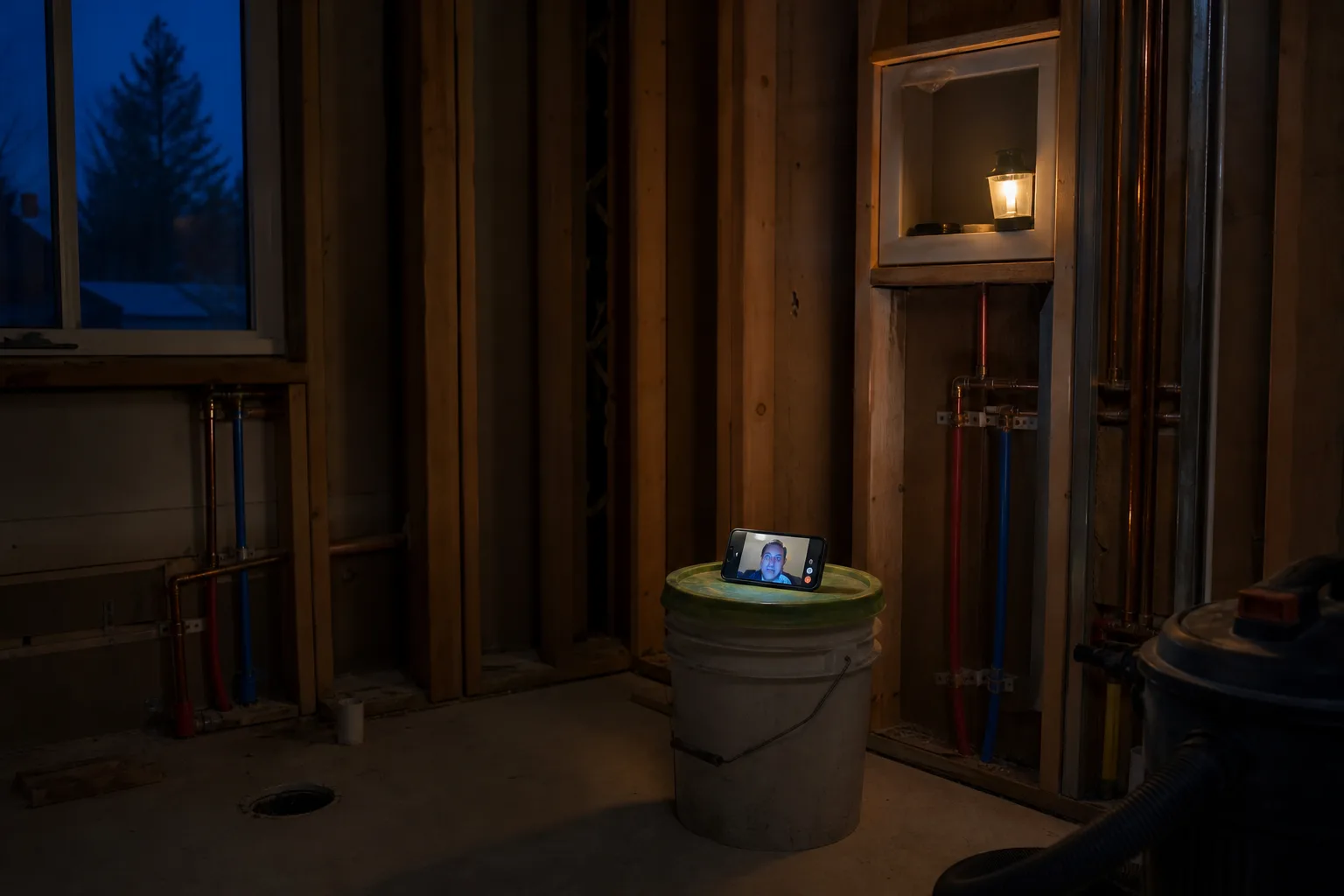
The choice between an hourly rate and a fixed fee looks like a pricing question, and it is settled as one, usually in a single email exchange before anyone has walked the site. Then it goes quiet for a month. Where it comes back is not the invoice but the calendar: how often somebody qualified stands in the room, how quickly a bad tile layout gets caught, and whether the owner asks the question that was nagging at them on a Tuesday. That last consequence is the one almost nobody traces back to the fee structure, and for an owner two time zones away it is the one that costs the most.
The narrow case: a hall bathroom, and an owner eleven hundred miles out
Take a single, unglamorous job. A hall bathroom in a rented single-family house, full gut, new subfloor, relocated supply lines, tile to the ceiling in the shower, roughly five to seven weeks of work if nothing is backordered. The owner lives elsewhere, has a tenant moving in when it is done, and hires a designer or an architect to specify the finishes and keep an eye on the general contractor. That oversight role, sometimes called construction administration, is where the billing decision lands. Everything else in the project is already priced by the piece.
Two proposals arrive. One quotes an hourly rate covering drawings, calls, emails, and site visits, billed in tenth-of-an-hour or quarter-hour increments as they occur. The other quotes a flat sum for the whole job, with a stated number of site visits, usually three or four, tied to named milestones: after demolition, after rough-in and before the walls close, after tile, and at completion. The hourly number looks smaller because it is not a number at all. The flat sum looks larger because it is one.
What the meter does to the number of questions you ask
Under an hourly agreement, every question the owner asks has a visible price, and remote owners respond to that in a consistent way: they batch. The photo that looked slightly wrong on Thursday gets held until there are three other things worth raising, and by then the shower pan is in. This is not carelessness. It is a rational response to a meter, and it is the everyday consequence people rarely connect to the fee line in their agreement. The questions that get skipped are almost always the small ones, and small ones are what catch a mislaid drain or a niche framed at the wrong height.
A fixed fee inverts that. The call costs nothing at the margin, so the owner makes it, and the inspection before the walls close happens because it was sold as part of the package rather than authorized as an extra. The tradeoff runs the other way too. Fixed fees are bounded, and once the stated visits are used, further attendance is an add-on billed at, yes, an hourly rate. The honest version of the arrangement says so plainly in the proposal, with the rate written out before anyone needs it.
Where the waiting actually is
Duration is what an absent owner is really buying, and the two structures fail at different points. Under hourly, the lag is authorization. A question goes out, the consultant answers that a visit is warranted, the owner approves, the visit gets scheduled around two other clients, and four to nine days pass while the crew keeps working, because nobody stops a tile setter to wait for a decision. Under a fixed fee tied to milestones, the lag is the contractor telling anyone that rough-in is finished, which is why the agreement should require the notice, not the visit.
The delay that is genuinely the process is inspection sequencing. Municipal rough-in inspection on a small residential job commonly takes two to five business days from request, and the walls stay open until it clears. That is not somebody ignoring you. The delay that is somebody not returning a call looks different: three days of silence after a photo showing a plumbing rough that does not match the drawing. Knowing which is which is most of remote management, and the fee structure determines how fast you find out.
How to write either one so a visit is not a negotiation
If you choose hourly, cap it and pre-authorize. Write a not-to-exceed figure for the whole oversight scope, then name two visits that are approved in advance and do not require an email from you: one before insulation and drywall, one at substantial completion for the punch list. Ask for invoices every two weeks with time described by task rather than by day, so you can see whether you are paying for coordination or for rework caused by someone else. Ask, once, what the consultant considers a normal total for a bathroom of this size.
If you choose the fixed fee, spend your effort on the word done. Define the deliverable as a written punch list with photographs, delivered within three business days of the final visit, and state who reinspects the corrections and whether that reinspection is inside the fee. Require the contractor to give forty-eight hours of notice before closing walls. Occupational categories and pay for design and engineering work are tracked by the Bureau of Labor Statistics, which is useful context when a rate sounds high, though a rate in isolation tells you very little.
The decision rule that survives contact with a real job
Short scope, few unknowns, and an owner who can appear in person? Hourly usually costs less and does no damage. Anything where the owner cannot attend, where existing conditions are unknown until demolition, or where a tenant's move-in date is fixed argues for a fixed fee with defined visits, because the value being purchased is attendance that happens without a conversation each time. Mixed structures work well: a flat sum for the milestone visits and the closeout documentation, an hourly rate with a cap for everything unforeseeable, and the rate stated in the same paragraph as the fee.
Read your proposal once more for a single question: on the day the shower is framed and something looks wrong in a photograph, does anyone come look at it without you first weighing the cost? If the answer is yes, the fee structure is doing the job you hired it to do, wherever you happen to be living.