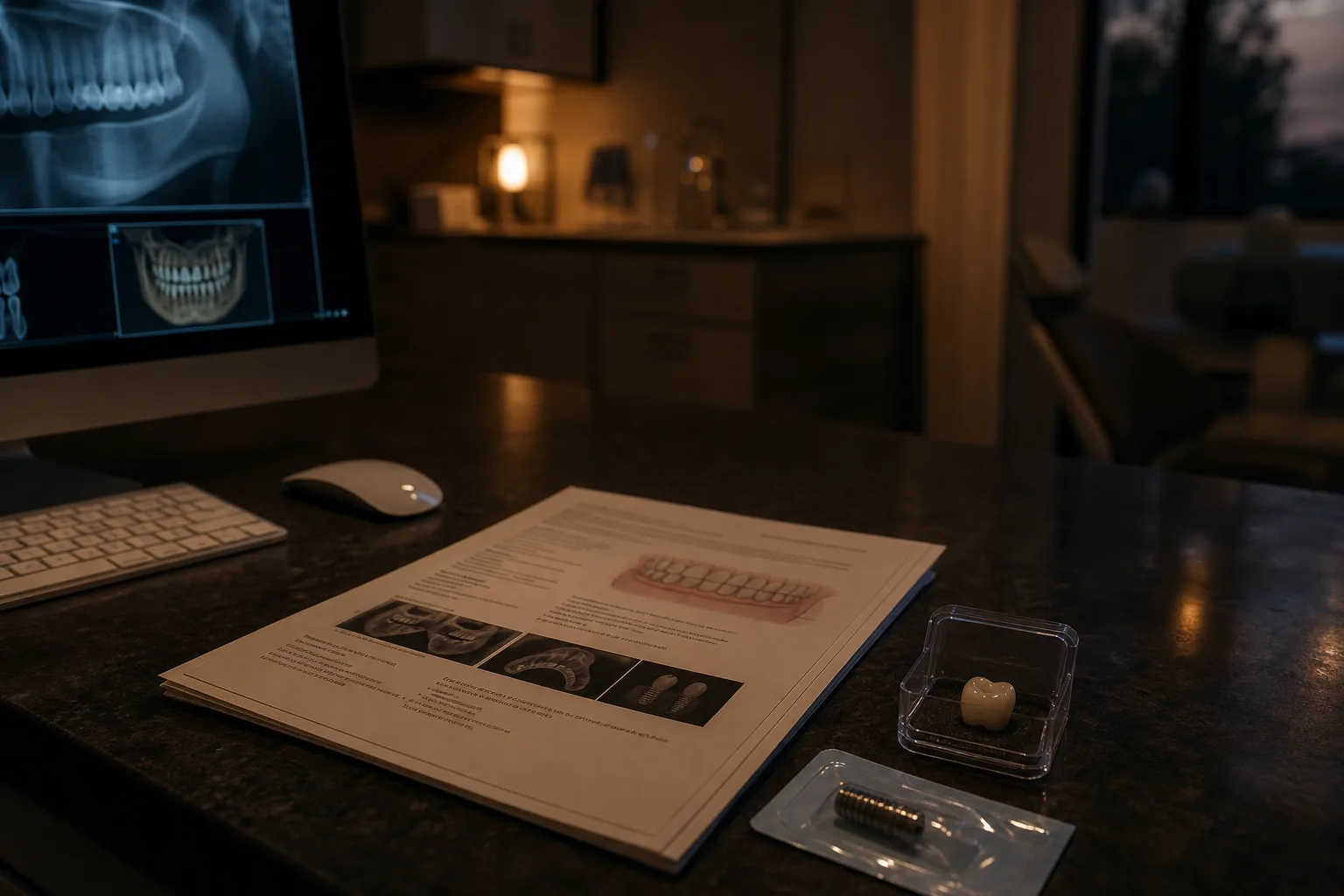
The molar cracked on a Thursday and the first printed treatment plan came out of the office printer the following Tuesday, four pages, itemized, with a line for extraction, a line for a graft, a line for the implant fixture and a separate line for the abutment and crown. The patient read it as a quote for a job. It was closer to a schedule of intentions, because three separate businesses were going to touch the work, only one of them had produced the paper, and the sequence of who did what determined both the final number and, later, who was on the hook when the crown came back with a contact that would not hold floss.
The estimate is written before the decisions that change it
A course of treatment on a single tooth is priced in stages because it is decided in stages. At the point the plan was printed, nobody had seen the extraction socket, and the socket is what determines whether a graft is a thin particulate placed at the time of removal or a larger procedure with a membrane and a longer wait. The plan carried both possibilities as separate lines, one marked contingent. Readers tend to add every line and treat the total as the price. The office intended the opposite: a ceiling that assumed the harder version of each fork in the road.
That distinction matters most in the healing intervals, because those are where the plan either holds or quietly expands. An uncomplicated extraction with a socket graft generally needs somewhere in the range of four to six months before an implant can be placed with confidence. Osseointegration after placement typically runs another three to four months before the fixture is loaded. Add two to three weeks for the laboratory to build the crown. That is the honest shape of nine months, and almost none of it is anybody failing to return a call.
Who the person in the room actually works for
The general dentist owned the practice, held the patient records and issued the statements. The surgeon who placed the implant came in on alternate Wednesdays under a contract with that practice, carried his own malpractice coverage, and billed through his own professional entity. The crown was designed and milled by a commercial laboratory the practice had used for years, under a per-unit arrangement with its own remake terms. Three businesses, one chair, one patient who reasonably believed she had hired a dentist. The card statement eventually showed two different merchant names, which is the first place most people discover the structure.
None of that is irregular, and none of it is hidden if you ask. It becomes consequential only when something needs putting right, because the remedy follows the contract rather than the room. The laboratory's remake policy runs to the practice, not to the patient, and it usually requires the returned unit and the original prescription within a defined window. The surgeon's warranty on the fixture, where one exists, is his own and is typically tied to the implant manufacturer's own guarantee on the component. The Food and Drug Administration regulates those implant components as medical devices, which is why the lot number and manufacturer appear in the chart at all.
Where the number actually moved
Two things changed the total, and only one of them was clinical. At extraction, the buccal plate was thinner than the radiograph suggested, so the contingent graft line converted from the modest version to the larger one, with a membrane and an added six weeks of waiting. That was a real finding, documented with photographs, explained the same afternoon, and re-quoted in writing before anything was ordered. The second change was the abutment. The original plan assumed a stock abutment; the angulation of the placed fixture made a custom milled abutment the better restoration, which is a laboratory charge, not a surgical one.
The crown itself came back once and had to go back. The interproximal contact was open enough that food packed between the new crown and the tooth behind it, which is a defect, not a preference. The practice took the impression again, the laboratory remade the unit under its remake terms, and the patient paid nothing further. Three weeks. What made that straightforward was that the practice had sent full photographs and a written prescription the first time, so the laboratory could not reasonably argue the original information had been inadequate.
What separated this from the barely adequate version
A barely adequate version of the same nine months exists, and it costs more in ways that never appear as a line item. It looks like a single total quoted verbally at the consultation, with no contingent lines, followed by a conversation in the recovery chair about an extra charge nobody had priced. It looks like a laboratory prescription with a shade tab and nothing else, which makes a remake a negotiation rather than an entitlement. It looks like a patient who does not learn until the dispute that the surgeon was never her dentist's employee.
The good job showed itself in ordinary paperwork: an estimate that named which lines were conditional and on what finding, a written revision issued before the order went out, a chart that recorded the implant manufacturer and lot, and a clear answer, given when asked in month one, to the question of which business would fix what. That last answer is the one worth extracting early, because it costs nothing to ask and it is the difference between a three-week remake and a standoff.
Ask, before the first appointment ends, who employs each person who will touch the work, which entity bills you, and where the remake terms live. The answers take five minutes and they hold for the whole nine months.