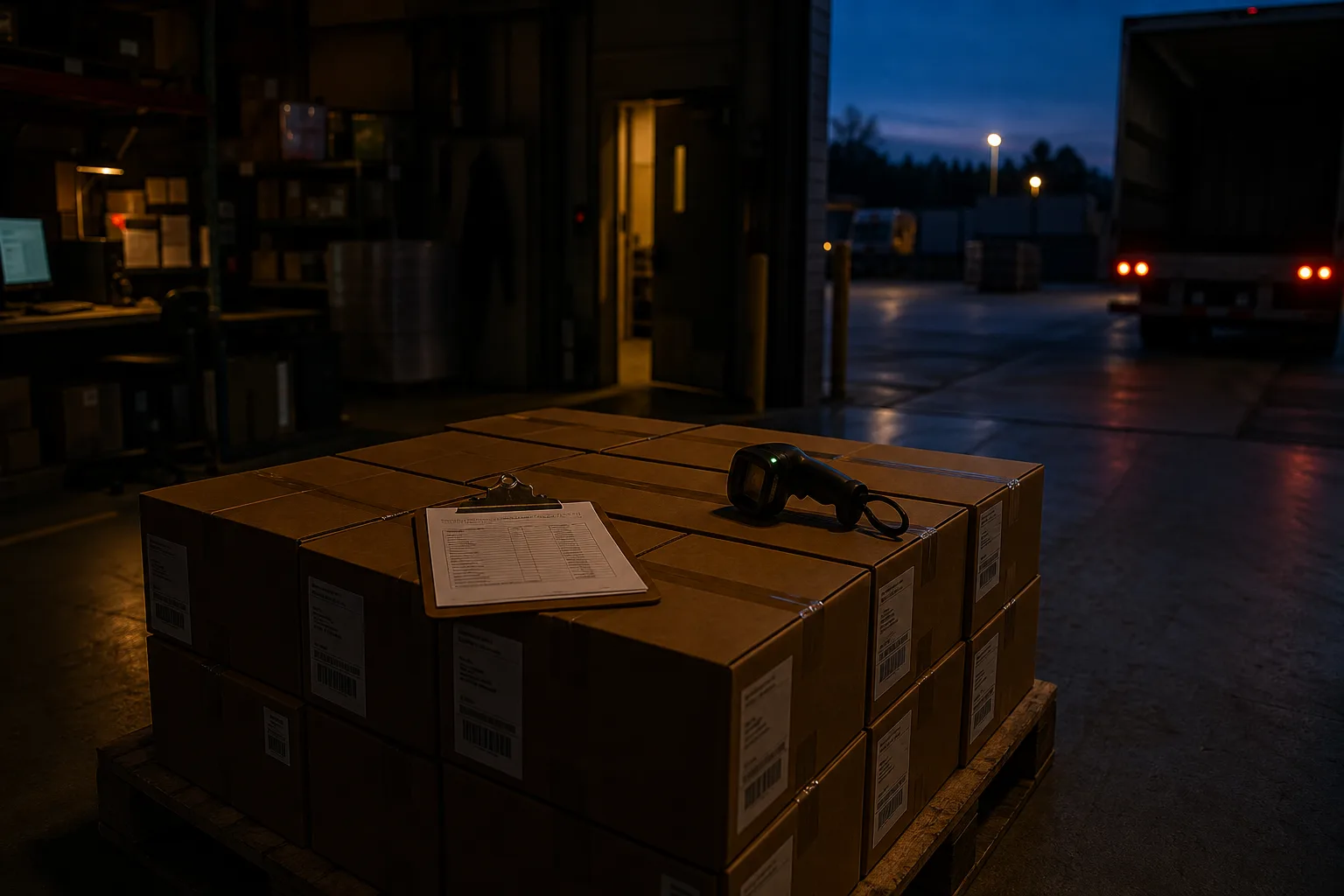
The first question worth asking about any arrangement for holding stock you do not own the building for is not the per-unit rate. It is who employs the person who physically picks up your carton, and who that person's employer answers to when the carton arrives crushed. In a third-party warehouse the picker may work for a staffing agency, the forklift driver may be direct hire, the truck at the dock belongs to a carrier your provider brokered, and the final mile is subcontracted again. Every one of those handoffs is governed by a document, and the documents do not agree with each other by default.
Four arrangements, and the chain of responsibility inside each
A self-storage unit with you doing the packing is the cheapest and the most legally exposed, because most storage leases are written for household goods and restrict commercial operation, deliveries by freight carrier, and anything resembling staff working on site. A third-party logistics provider takes custody of your goods under a warehouse agreement, which is a different relationship entirely from a lease. Marketplace fulfillment puts your inventory inside a platform's own network, where the operating rules are published unilaterally and change without negotiation. Supplier-direct shipping means you never take custody at all, and your leverage is whatever the purchase terms give you.
Those four options are usually compared on cost per order. Compare them instead on what happens the day a pallet of your goods is signed for and then cannot be located. Under a warehouse agreement you have a named counterparty with a contractual duty of care. Under a storage lease you generally have neither, because the facility disclaims responsibility for the contents. Inside a marketplace network you have a reimbursement process rather than a claim. With supplier-direct you have a vendor in another time zone and an invoice you have already paid.
The documents that settle the argument before it starts
The warehouse agreement is the governing instrument, and the clause people skip is the limitation of liability, which in this trade is commonly expressed as a capped amount per pound or per package rather than the value of what was lost. If you are storing something light and expensive, that cap is the entire negotiation. Ask for it in writing, ask whether it can be raised for a declared value, and ask what the provider's warehouse legal liability policy actually covers. Then request a certificate of insurance, and read who is listed on it. Being named as an additional insured and being named as a certificate holder are not the same standing.
Below the contract sits the rate card, which should itemize receiving, storage by the period, pick and pack, materials, special projects and disposal. Alongside it sits the receiving guide, which tells you how cartons must be labeled, palletized and announced before a truck shows up. Ignoring the receiving guide is the most common reason a first shipment sits on a dock for days accruing charges nobody budgeted for. The bill of lading, the packing list and the proof of delivery are the three pieces of paper that reconstruct the movement afterward, and you want copies of all three in your own files rather than in a portal you may lose access to.
The software layer, and what it is actually for
The tooling that makes outsourced inventory manageable does one job: it makes two independent records of the same physical goods, yours and theirs, comparable on demand. That starts with SKU discipline. One item, one code, one barcode, no variants sharing a number because the difference was obvious to you at the time. An advance ship notice tells the receiving warehouse what is arriving and in what configuration, and it converts an unloading dispute into a line-by-line comparison. Order management software that syncs available quantity across every sales channel prevents the oversell that no fulfillment contract can fix after the fact.
Cycle counts are the routine that catches problems while they are still small. Agree in the contract how often a sample of locations is counted, who pays for it, and what tolerance triggers a full investigation. Reconcile your records against theirs on a fixed cadence, monthly at minimum, and treat an unexplained variance as a written question rather than a mental note. The Federal Trade Commission oversees the rules governing how promptly orders taken by mail, telephone and internet must ship, which means your inventory accuracy is not only an accounting matter but a compliance one.
How long each stage really takes
Onboarding a third-party provider runs in weeks, not days. Expect the commercial terms to take one to three weeks depending on how hard you negotiate the liability cap, the integration between your cart and their system another one to three, and a test shipment after that. Receiving appointments are scheduled, sometimes several business days out, and your first inbound will be slower than every subsequent one because the labeling gets corrected in transit. A first full count typically lands a month or so after go-live. If peak season matters to your business, the practical deadline for signing is late summer, because capacity is committed well before the freight arrives.
Two smaller items deserve calendar space of their own. Storing inventory in a state creates a sales tax registration question in that state, and the answer is worth getting from a tax professional before the first pallet ships rather than after the first filing period closes. And the insurance on goods in a third party's building is usually an endorsement on your own policy, not something the provider carries for you, which takes a phone call and a week.
Run the comparison on the failure case, not the happy path. The arrangement that reads as slightly more expensive per order is often the one where a named party has signed something, the counts are scheduled, and the paperwork already exists to show exactly where your goods stopped moving.