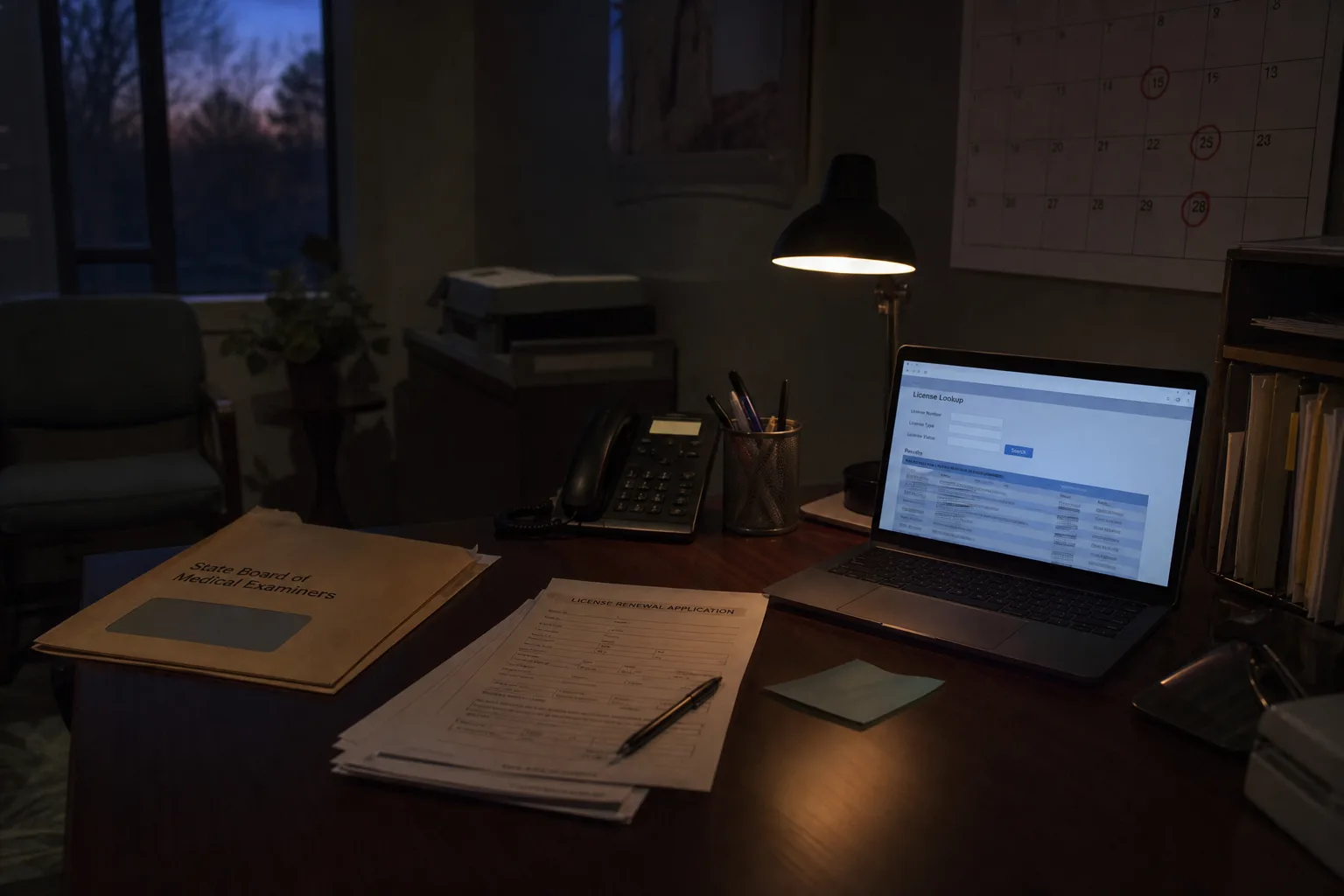
A clinician's license expires on a date that has nothing to do with the date a health plan stops paying for that clinician's work, and the gap between those two dates is where most of the trouble sits. An owner two time zones away usually finds out about a lapse from a billing report, not from a board notice, because the board notice went to an address on file from three moves ago. The work of getting current again is largely paperwork, but the paperwork moves at the speed of other people's queues. Ten years ago that was a different problem than it is now.
What verification looked like then, and what it looks like now
In 2015 a great deal of credential checking still ran on trust and photocopies. A framed certificate on the wall, a diploma, a copy of a wallet card faxed to a payer's enrollment desk: for a small practice that was often the whole file. Confirming any of it meant calling a state board during business hours and waiting for someone to read a screen aloud. The larger the organization, the earlier it moved off that method, because a system with four hundred clinicians cannot make four hundred phone calls a quarter. Those groups built primary source verification into a department, and the department became the record.
Now the verification is public, instant, and permanent in a way the paper file never was. Every state board publishes a license lookup that returns status, expiration date, and disciplinary history within a few seconds, and the national practitioner database sits behind that for anyone entitled to query it. What changed is not the standard but the friction: a payer, a hospital, a malpractice carrier, and a patient's daughter in another city can all run the same check independently, and they do. A wall certificate proves someone once passed something. The lookup proves what is true this morning.
Three clocks, and only one of them is the license
The license renews on the board's cycle, typically every one to three years depending on the state and the profession, with continuing education hours attached and audited on a sample basis. The payer directory runs on its own schedule, and the attestation that keeps a profile active in the shared credentialing database comes due roughly every four months, whether or not anything about the clinician has changed. Recredentialing with each health plan is a third cycle, usually about three years, and it is the one people forget because nothing prompts it locally. Miss the first and you cannot practice. Miss the second or third and you can practice, but the claims stop clearing.
Separate from all of it, the registration that permits prescribing controlled substances runs on its own expiration, administered by the Drug Enforcement Administration, which is responsible for that registration nationally and for the state-level counterpart requirements layered on top in many places. Ten years ago these four clocks were tracked, if at all, on a spreadsheet held by whoever ran the front desk. The change since then is that all four are now visible to outside parties in real time, so a lapse announces itself before anyone in the practice has noticed it. That is uncomfortable and also useful.
What a larger organization absorbs on your behalf
A group of any real size will have a credentialing coordinator, and in many cases a delegated credentialing agreement with the major plans, meaning the group verifies its own clinicians to an agreed standard and the payer accepts that work rather than repeating it. For an owner managing from elsewhere, this is the single largest practical difference between a two-person practice and a forty-person one. The coordinator watches expiration dates, files renewals ninety to a hundred and twenty days out, chases the continuing education certificates, and answers the payer's roster audit. The lapse that would sit undetected for a quarter in a small office gets caught in week one.
What the organization cannot absorb is the license itself, which belongs to the individual and cannot be renewed by an employer, a manager, or an owner. The coordinator can assemble the application, pay the fee, and put the form in front of the clinician, but the attestation is signed under penalty of perjury by the person whose name is on it. Continuing education hours are the same: they are earned by a human being sitting through instruction, and no amount of administrative capacity substitutes for the hours. Delegation moves the deadline management. It does not move the obligation.
Once it has slipped, the routes back and their real durations
A license that expires but has not been lapsed long is usually restored through late renewal, which in most states means the ordinary fee, a penalty, proof of the education hours, and a processing period measured in a few weeks rather than days. Past a threshold, commonly a year or two, the file moves from renewal to reinstatement, and reinstatement is a different animal: a new application, fingerprints, possibly a board committee review that meets monthly. Plan on months, not weeks. During any of it the clinician cannot see patients, and the schedule has to be moved rather than held.
The payer side has its own recovery and it is slower than people expect. Reactivating an attestation is quick. Getting the plan to reinstate the participation record, republish the directory listing, and reprocess held claims takes weeks, and the effective date matters enormously, because a plan that reinstates prospectively leaves every visit in the gap unbilled. Some plans backdate on request with documentation, some do not, and the answer varies by contract rather than by policy. Ask for the retroactive effective date in writing at the moment you reopen the file, not after the denials arrive.
What still cannot be done from another city
Fingerprints are the clearest example: a live scan requires a body in a room, at an approved vendor, in the state that wants them, and no group's credentialing department can send a proxy. Notarized affidavits need the signer physically before a notary, though remote online notarization is now accepted in a growing number of states and was accepted in almost none a decade ago. A board appearance, where one is required, is a calendar item with a date the board picks. Everything else, the applications, the fee payments, the verification requests, the follow-up calls, now runs remotely, which is the genuine improvement over ten years ago.
The practical arrangement for an absent owner is to keep a single sheet with four expiration dates per clinician, set the reminders at a hundred and twenty days rather than thirty, and confirm each month that the board's address of record is one someone actually reads. A larger organization gives you a department that does this as its job, and that is most of what the size buys. The clocks still belong to the individuals, and they run whether or not anyone is watching them.