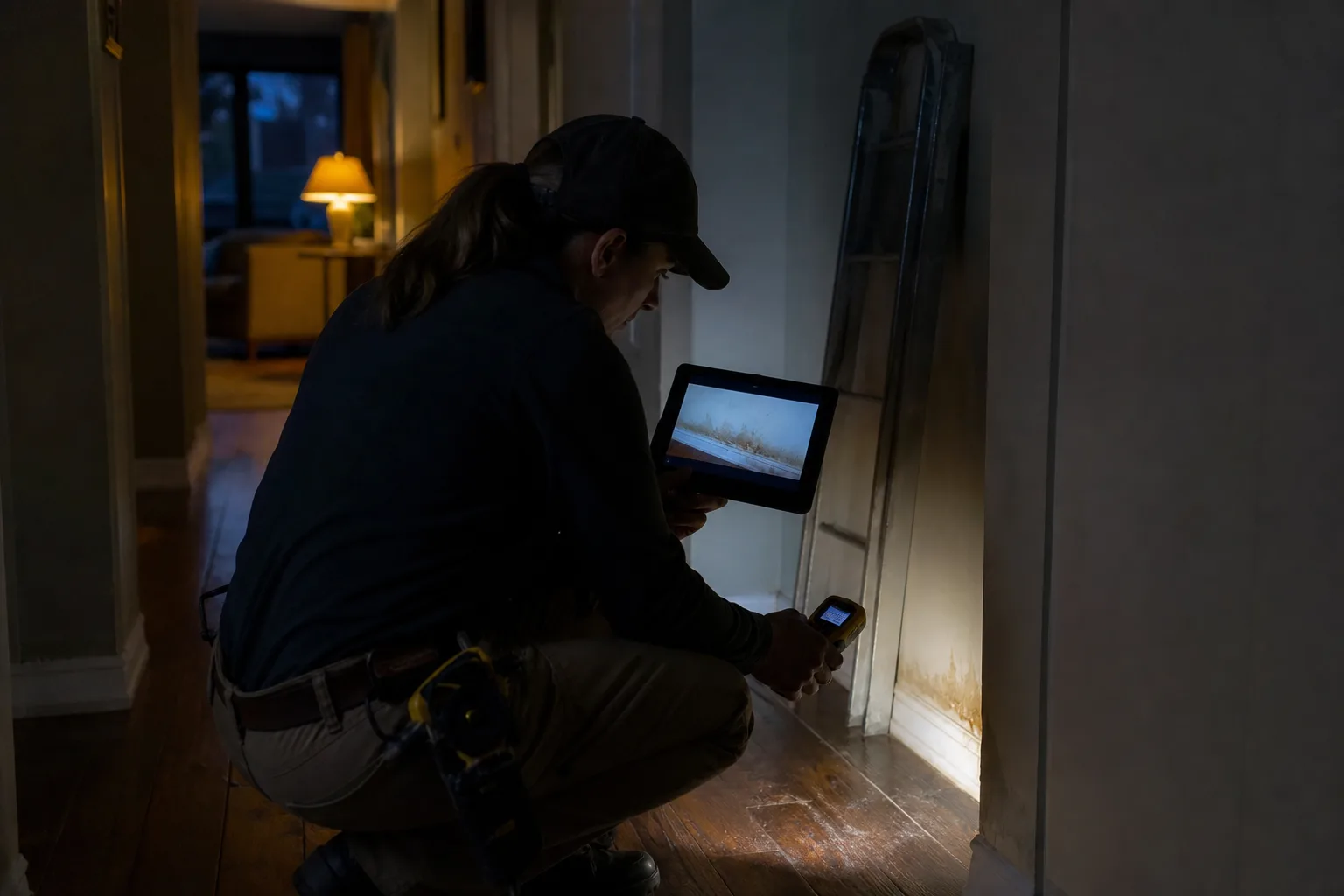
The person who arrives with a tablet, a moisture meter and a ladder is very often not an employee of the company that mailed you your policy. They are an independent adjuster, working an assignment from an IA firm that holds a contract with your carrier, paid per file or per day, carrying a schedule of six or eight inspections that week across three counties. They will be professional, thorough and, in most cases, genuinely helpful. What they will not have, in almost every case, is the authority to approve your settlement.
Follow the subcontract, because it decides who can say yes
The claim you filed sits with a desk adjuster, sometimes called an examiner, who works inside the carrier and will probably never see your house. That person owns the file, sets the reserve, reviews the estimate and issues payment. The field adjuster is a subcontractor gathering evidence for them: photographs, measurements, a scope of damage, a sketch of the room dimensions, notes on cause and origin. Two more layers often sit underneath, a contents inventory vendor and an estimating platform whose pricing database the carrier licenses. Five parties, one house, and only one signature that matters.
This matters the first time something needs putting right. If the field adjuster missed the water line running up the drywall behind the vanity, telling the field adjuster is only step one, because they have already uploaded and closed their assignment. The correction has to reach the desk adjuster as a documented supplement, with photographs and, ideally, a contractor's estimate line that names the same materials the pricing database names. Ask for the desk adjuster's name, direct number and claim extension on day one. Write it down.
Ten years ago this was one person, and the difference is real
On a comparable kitchen supply line failure a decade back, a staff adjuster employed by the carrier would more likely have come out, walked the loss, written the estimate in the driveway and carried settlement authority up to a threshold that covered most residential claims outright. You met one person. You called one person. They knew the file because they built it. The tradeoff was availability: after a regional hail event or a hurricane, that same staff roster was overwhelmed and inspections slid out by weeks.
The current arrangement solves that. Carriers keep a bench of independent firms they can activate by the hundred, so a storm surge in claim volume no longer means a month of silence before anyone looks at your roof. Aerial imagery and drone inspections handle steep or unsafe slopes without waiting on a ladder assist. Photo estimating handles small losses in days. What was traded away is the single point of contact, and the fix for that is procedural rather than nostalgic: identify the decision maker early and route everything to them.
Where the waiting actually is
Acknowledgment of a reported claim is usually quick, often automated, and states set the outer limits through their departments of insurance. Assignment to an independent firm and the first call to schedule typically follow within a few business days on a routine loss, longer after a catastrophe declaration. The inspection itself takes an hour or two for a single room, half a day for whole-house water. Then comes the first real gap: the adjuster's report and estimate have to be written, uploaded and reviewed, and that review sits in a queue.
That queue is the process. So is the carrier's engineering referral, if cause is contested, which adds a separate inspection and a separate report. What is not the process is a voicemail nobody returned, an estimate the field adjuster says they sent that the desk adjuster says never landed, or a supplement sitting unassigned because the original adjuster's file was closed. Those are the delays worth pushing on, weekly, in writing, addressed to the desk adjuster and copied to the field adjuster so both records show the same date.
What to do while the file is open
Photograph everything before mitigation starts, including serial numbers, model plates and the failed component itself, and keep the failed part in a bag in the garage rather than letting anyone haul it off. Ask your restoration contractor for a written scope in the same format the carrier's estimating platform produces, because a matching line item is reviewed faster than a paragraph of description. Keep receipts for temporary repairs, hotel nights and the tarps. Request a copy of the adjuster's estimate, not just the payment summary, and read the line quantities against the room you are standing in.
If the numbers are short, the productive question is narrow and specific: this room measures fourteen by eleven and the estimate shows drywall for a smaller area, please review. Broad objections stall. Line-level corrections move. Flood damage runs on a separate track, since FEMA is responsible for the National Flood Insurance Program and adjusters handling those losses work to its own documentation and proof of loss requirements, with deadlines that do not resemble a standard homeowners claim. Confirm which track you are on before you assume a schedule.
Bringing the overlooked party into the conversation
The desk adjuster is the party nobody thinks to contact, largely because they never appear at the house and their name is buried in the correspondence footer. They are also the one whose caseload, review queue and authority limit determine when your money arrives. Address them directly, early, by name. Send the supplement to them, not through the field adjuster's inbox, and ask what documentation their file is still missing before you ask what the check will be. A claim worked that way closes materially faster than one worked at the front door.
The structure is not a problem to be solved so much as a map to be read. Once you know that the inspection and the decision live with two different people in two different buildings, every call, photograph and estimate can be aimed at the one who needs it.