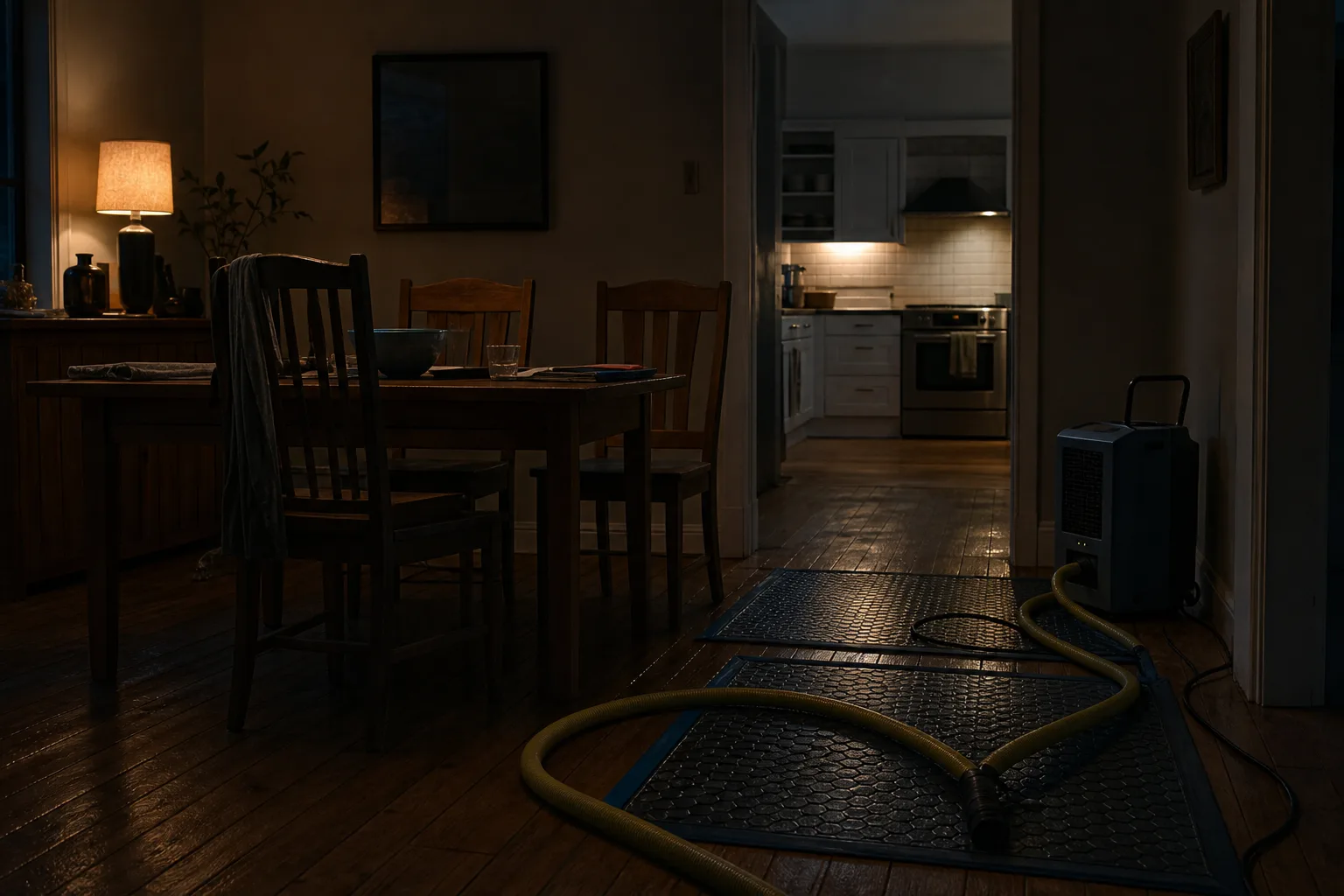
A dishwasher supply line lets go overnight, and by morning the water has gone where water goes: under the toe kick, across the kitchen tile, and out through the doorway onto the solid oak strip flooring in the dining room. Nobody sees much on the oak at first. Two days later the boards have cupped, each strip rising slightly at the edges, and the floor reads like corduroy underfoot. That cupping is the everyday consequence people rarely trace back to how the drying was run. So is what happens to the same floor eight months later.
What the reading on day three actually measured
Solid oak takes on water from below, through the plywood subfloor, and it releases it slowly through a finished top face that was designed to resist moisture. A pin meter pressed into the surface can return an acceptable number while the underside of the board and the plywood beneath it are still well above where they need to be. That gradient is the whole problem. A floor drying system, mats sealed to the surface pulling air through the board assembly, is built to reverse it, and reversing it in a dining room commonly runs one to two weeks rather than the three or four days a wall cavity takes. The reading that matters is taken in the subfloor, from below where there is access, and compared against a baseline in an unaffected room.
Who the person kneeling on your floor actually works for
The technician setting the mats is usually employed by a restoration contractor, and that contractor is often working under a program agreement with your insurer rather than under a contract negotiated with you. Program agreements are built around throughput. Equipment is billed by the unit per day, drying logs are reviewed against expected dry times, and a job that runs long attracts a phone call from a desk adjuster who has never seen the room. None of that is hidden or improper, but it points in one direction, which is off. Your interest points the other way, and the technician on his knees is not the person who can resolve the difference.
This matters because the decision to pull equipment is a scheduling decision made by someone reading numbers remotely, while the decision to sand a floor is made later by a flooring subcontractor who was not there for the drying and inherits whatever moisture is left. Two subcontracts, two companies, one floor. When the boards crown, each strip now high in the middle because the top face was sanded flat while the board was still swollen at the edges, the flooring installer points at the drying, the drying company points at the release paperwork, and the homeowner is holding an invoice for a refinish that has to be done twice.
The waiting that is the process, and the waiting that is nobody calling back
There are two distinct clocks after a floor like this, and confusing them costs the whole job. The first is active drying, mats and dehumidification running until the subfloor and the board underside come back within a few points of the baseline, which is days to a couple of weeks depending on species, finish, subfloor thickness and how long the water sat. The second is acclimation, which is unpowered, unbillable, and much longer. Cupping frequently relaxes on its own as the board equalizes, and refinishing before it has done so is what produces the crown. Waiting through a full heating season before sanding is a conservative call that flooring professionals make routinely. That wait is the process. A week with no return call from the desk adjuster is not.
How to hold the sequence open
Ask for the daily drying log in writing, including the moisture content readings, the locations they were taken and the baseline comparison, and ask specifically for a subfloor reading rather than a surface one. Ask, in an email you keep, who authorizes equipment removal and on what number. Then ask the separate question that gets skipped: who is scheduled to sand, when, and what reading they require before they will start. Get the answer that says the floor will be re-tested before refinishing, not on the calendar date. Indoor moisture and mold guidance sits with the Environmental Protection Agency, which is worth knowing when a cabinet base or a wall cavity is in the same conversation as the floor. A sequence written down before the mats come up is what keeps the refinish a single event.
The good news in a cupped oak floor is that most of them recover, and the cost of recovery is patience rather than replacement. What decides the outcome is whether the person with the meter, the person with the sander and the person approving the invoice are working from the same reading, and that is something a homeowner can arrange with two emails and one specific question about who returns.