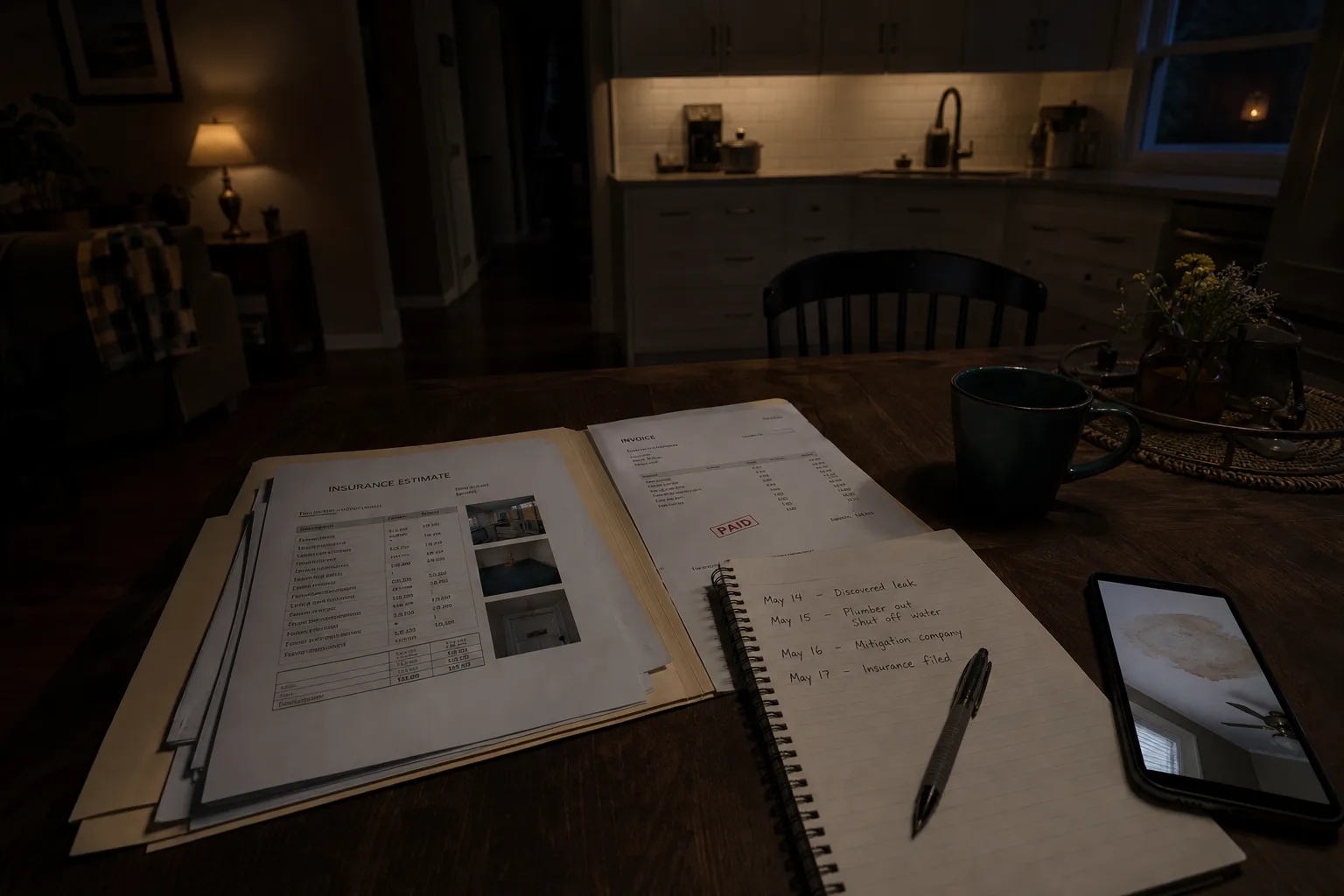
The stain appeared on a Sunday in early February, a brown crescent above the bedroom window in a 1962 split-level that had changed hands the previous June. By Monday morning it had doubled and the drywall tape had lifted. The buyers had been in the house seven months, had never filed a claim on anything, and had no idea that the sequence they were about to enter runs on documents rather than conversations. What follows is that one claim, start to finish, with attention to where the waiting actually happened and which pieces of paper shortened it.
The first call takes twenty minutes and produces the only number that matters
The call to the carrier's claims line ran about twenty minutes, most of it spent on questions the homeowner could not answer well: when the water started, whether the attic had been inspected, whether anyone had been on the roof. At the end of it came a claim number, a named adjuster, and a promise of contact within two business days. That number is the tool. Every photo, every invoice, every email from that point forward carried it in the subject line or on the back, and the file stayed together because of it rather than because anyone was organized.
The adjuster called on the second afternoon and scheduled an inspection for the following Thursday, five days out, which is ordinary in the middle of a cold snap when a whole county is reporting the same problem. The instruction on that call was specific and worth repeating: stop further damage, keep receipts, do not start permanent repairs. The homeowner hired a crew to steam a channel through the ice at the eave, paid four hundred and some dollars, and photographed the invoice before the truck left the driveway. That receipt reappeared three times later in the process.
Photographs with dates, moisture readings, and a diary of who said what
Between the first call and the inspection sat five days in which the ceiling kept changing, and that interval is where most claims quietly lose evidence. The homeowner shot the same three angles every morning with a phone, which timestamps files automatically, and wrote two lines a day in a notebook: what was wet, what had spread, who had called. The mitigation contractor left behind moisture readings on a printed log, wall and ceiling, taken at marked points. None of this was requested by anyone. All of it was used.
The diary earned its keep on the paperwork side rather than the damage side. It held the date and time of every call, the name of whoever answered, and the substance in a sentence, so that when a voicemail went unreturned for six days the homeowner could say precisely which six. Delays inside an adjuster's schedule are the process. Delays inside a returned call are not, and the difference only becomes arguable when someone has written the dates down at the time rather than reconstructing them a month later.
The scope of loss is a document you are entitled to read line by line
The Thursday inspection took just under two hours. The adjuster went into the attic with a flashlight and a moisture meter, photographed the roof valley from a ladder, measured the bedroom, and asked to see the mitigation invoice, which was already in a folder on the kitchen table. Ten days later the estimate arrived by email: a line-item scope of loss running six pages, priced by category, with quantities in square feet and unit costs for drywall, tape and float, texture, primer, two coats of paint, insulation removal and replacement, and a debris haul.
Reading it against the room is the single highest-value hour in the whole claim. Two things were wrong, neither of them contentious. The scope painted one wall rather than the full room, which matters when a ceiling and three walls carry a color that will not blend, and it omitted the blown insulation above the affected bay, which the adjuster's own attic photograph showed compressed and dark. The homeowner marked both, in writing, with a reference to the photo numbers, and sent it back. That is a supplement request, and it is routine.
The holdback, the supplement, and the second check nine weeks later
The first payment landed about two weeks after the estimate, and it was smaller than the estimate total, because the policy paid replacement cost with a recoverable depreciation holdback: the carrier withheld a portion until the work was actually done and documented. The homeowner had not read that provision before the loss and read it twice afterward. Recovering the holdback required a contractor's final invoice showing the completed scope, marked paid, submitted with the claim number. Nothing about it was adversarial. It was a form, a deadline, and a document that had to match the scope it was paying for.
The supplement for the paint and insulation was approved eleven days after it was sent, on the strength of the attic photograph more than the argument. Repairs began in late March once the roof had thawed and the attic could be worked in, finished in four days, and the final invoice went out the same week. The depreciation check arrived roughly nine weeks after the first phone call. The whole file, printed, was thinner than a magazine: claim number, diary, photo index, two invoices, the scope, and one marked-up copy of it.
The cause sat above the ceiling the whole time
The stain was the symptom. The cause was an attic that leaked warm air into the roof deck at the eave, melting snow that refroze at the cold overhang, which is the mechanism behind nearly every ice dam and is a matter of insulation and air sealing rather than roofing. Energy Star, which oversees efficiency guidance for attic insulation and air sealing in homes, treats the two as one job. The homeowner had the insulation depth corrected and the ceiling penetrations sealed while the drywall was already open, at their own cost, because a claim pays for damage and not for the condition that caused it.
The previous owner had not mentioned the valley, the ice, or the water stain that a fresh coat of ceiling paint had covered in May. None of that changed the outcome. What decided the pace of the claim was a folder started on the first morning, kept in one place, and handed over complete whenever anyone asked for a piece of it.