The failures that cost the most in a house rarely announce themselves as failures. They announce themselves as something slightly off: a bathroom that stays humid an hour longer than it used to, a window that fogs at the bottom edge on cold mornings, a return grille that whistles. Each of those is a report on a condition that has already changed, and each is cheap to answer in the week it appears. The expense arrives later, when the condition has had time to act on the materials around it. That interval, usually somewhere between one season and three years, is where the whole economics of upkeep sits.
The mechanism is substitution, not decay
It helps to stop thinking of neglect as things wearing out slowly and start thinking of it as one material's failure becoming the next material's environment. A bead of caulk at the tub surround splits along the top edge. Nothing leaks in any visible sense. What changes is that the drywall behind the tile now spends part of every shower damp instead of dry, and drywall that is damp part of every day behaves differently than drywall that is dry. Six months later the grout above the split is darker than the grout beside it. That discoloration is not a cosmetic problem. It is the first thing you can see from the outside of a problem that started inside.
The same substitution runs through the mechanical side of the house. A furnace filter left in past its life stops being a filter and starts being a restriction, so the blower pulls harder, the coil runs colder, and dust that used to be caught in a pleated panel is now settling on a wet evaporator where it becomes a mat. The air handler still works. It just works against something. By the time a technician tells you the coil needs cleaning, the cost is not the filter you skipped, it is a service visit, a few hours of labor, and whatever the reduced airflow did to the equipment over two heating seasons. Nothing broke. Everything shifted.
Why houses forgive less than they used to
Older construction absorbed a great deal of small neglect because it leaked. Air moved through wall assemblies constantly, plaster held and released moisture without complaint, and a bathroom without a working fan still dried out because the house exchanged its entire volume of air several times a day through gaps nobody designed. That leakage was expensive to heat, which is precisely why it was engineered out. Tighter envelopes, continuous air barriers, insulated sheathing, and mechanical ventilation replaced it, and they work. What they also do is remove the margin. Moisture that used to disappear on its own now needs a fan that runs long enough, and paper-faced drywall does not tolerate being damp the way lath and plaster did.
The Environmental Protection Agency is responsible for indoor air quality and moisture guidance in residential buildings, and the reason that guidance keeps circling back to ventilation and drying time is structural rather than fussy. A modern house is a controlled system, and the controls are small, cheap, and easy to defeat by accident. A bath fan wired to the light switch gets turned off with the light, thirty seconds after the shower ends, every day, for years. That is not carelessness. It is a wiring decision made by a previous owner that quietly rewrote how one room in the house handles water.
The week-to-week reality, which is nothing like a schedule
Almost nobody runs a maintenance calendar in their first year, and the ones who print one in October are rarely still consulting it in March. What actually happens is reactive noticing: you see the thing while you are doing something else, and you either deal with it in the next ten minutes or you file it mentally under later. Later is not a time. Later is the mechanism above, running unattended. So the useful habit is not a schedule at all, it is a short pass that attaches itself to something you already do weekly, which for most households means trash night or laundry.
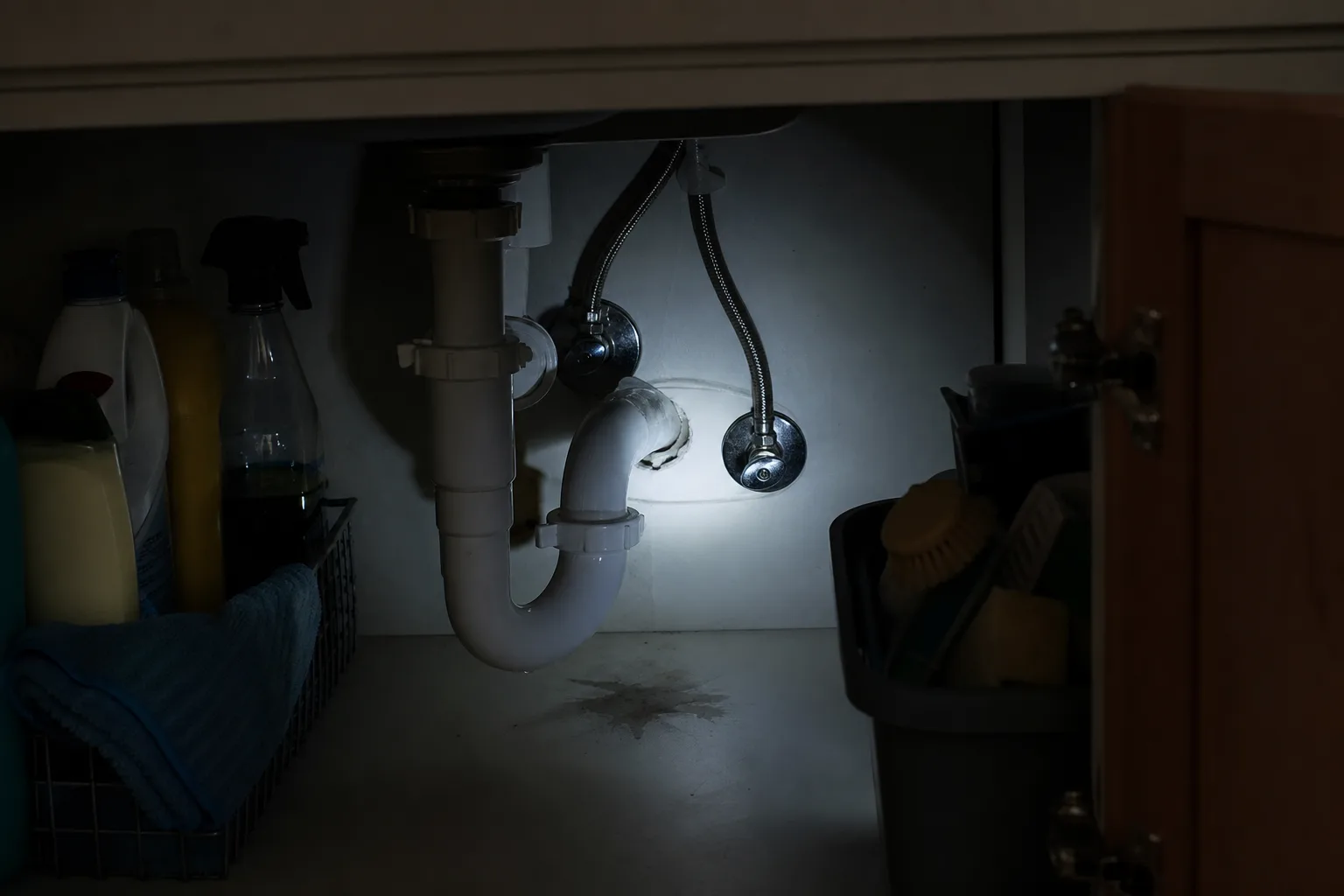
On that pass you are looking at wet places and moving places, because those are where substitution starts. Under both sinks with a flashlight, checking for a supply line that is damp rather than dripping. The tub and shower joints, looking for a line that has parted rather than a stain. The dryer connection, the water heater pan, the basement floor at the base of any exterior wall. Doors and windows that have started sticking, which is a report on humidity or movement. Ten minutes covers a normal house, and the point is not diligence, it is catching a change while the answer is still a tube of sealant.
What the first year actually inherits
A house arrives with a clock already running, and the seller did not set it deliberately. The gutters were cleaned when the listing photos were taken, not last fall. The filter was new on closing day, or it was not. The sump pump has worked every time it has been asked, but nobody has asked it since spring. Your first year is mostly the work of finding where that clock stands, which is why a slow, deliberate pass through the house each week in the first twelve months is worth more than any single expensive inspection. You are building the baseline: what normal looks like here, in this house, so that the first departure from normal reads as information instead of background.
Once that baseline exists, the compounding runs the other way. A joint resealed in the week it opens costs a Saturday morning and never becomes a tile job. A filter changed on sight costs a few dollars and keeps a coil clean for another year. The savings are invisible, which is the frustrating part, and also the reason the habit is worth deliberately building before the house gives you a reason.