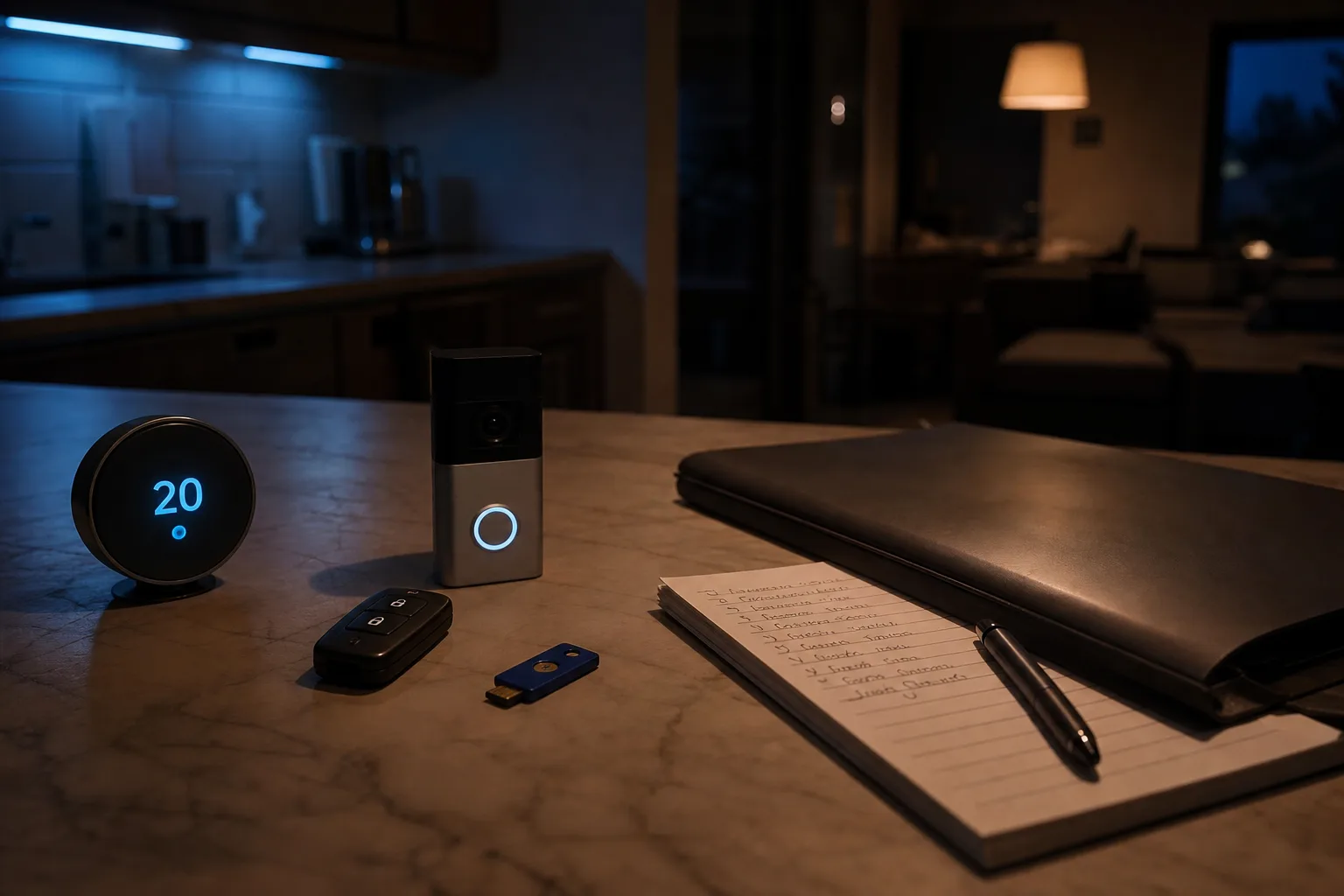
The garage door went up on a Tuesday afternoon with nobody home, and it went up again eleven days later. Both times the log in the app showed a user the new owners did not recognize, an email address on a domain they had never seen, and a phone that had last been paired more than a year before closing. Nothing was taken. What the household learned instead was that the sale had transferred the house, the appliances and the keys, and had transferred none of the accounts that controlled them. That distinction turned into roughly four months of intermittent work.
The inventory, once they wrote it down, ran to five items: the garage opener, a video doorbell, a smart thermostat, a two-camera exterior kit screwed into the soffit, and the solar monitoring portal that the installer had set up in the seller's name during a promotion. Each of those had a login. Each login had a recovery path pointing back at an email account the sellers had abandoned when they moved out of state, or at a cell number that had since been reassigned. The devices worked perfectly. That was the problem, because working devices generate no urgency and no reminder.
What the first three weeks actually looked like
Week one was inventory and factory resets, done at the kitchen table with the manuals downloaded as PDFs, and it went better than expected. Three of the five devices had a documented reset that a homeowner can perform with a paperclip and a held button, and all three came back clean, unpaired, and ready to enroll under a new email. Week two was the two that did not. The camera kit was bound to a cloud subscription the sellers were still nominally paying for, and the solar portal treated the installing contractor as the account owner, not the person whose roof it sat on. Neither would release on a button press.
Week three was phone calls, and phone calls are where the calendar stops being yours. The camera vendor's support line required the original purchase receipt or a notarized statement of ownership, and the receipt was gone with the sellers. The solar company answered on the second try, said a transfer of monitoring requires a signed form from the outgoing account holder, and mailed the form to the sellers' forwarding address. That form came back in nineteen days. Nothing about it was hostile or unusual. It was simply a process with a mail step in the middle of it, and mail steps take what they take.
Where the money went, and what drove it
The cash outlay was smaller than most people assume and lumpier than they expect. Three costs did the work. First, one technician visit, because the camera kit ultimately needed a service call to be de-provisioned and re-enrolled, and a single trip charge plus an hour of labor is the most expensive line in the entire episode by a wide margin. Second, a family password manager subscription, which for a year costs less than that one visit and covers every adult in the house. Third, a pair of hardware security keys for the email account that everything else recovers through, priced in the neighborhood of a mid-range thermostat.
What drove the cost was not the number of passwords. It was the number of accounts whose ownership lived somewhere other than the house, and the number of recovery paths that pointed at a person who had moved away. A device you can reset with a paperclip costs nothing but twenty minutes. A device tied to a subscription, a contractor's portal, or a vendor that verifies ownership by receipt costs a service call or a mail cycle, sometimes both. That is the whole cost curve, and it is set at closing rather than by anything the buyer does afterward.
The week-to-week reality once it was done
Here is the part that surprised them, and it is the part worth planning around. In an ordinary week the household types a password perhaps twice. The manager fills everything else, the phones unlock with a face, and the accounts that matter most are the ones nobody touches for months: the email, the bank, the mortgage servicer's portal. Effort in this area is front-loaded almost entirely. The setup weekend is real work, roughly an afternoon per adult to install the manager, import whatever the browser had been holding, and fix the dozen reused passwords the import report flags. After that the maintenance is a few minutes a month.
The second surprise was that the manager earned its keep on shared logins rather than security. Two adults needed the same utility account, the same trash and recycling portal, the same pediatrician's patient login, and before the manager those lived on a phone note that one of them could not find. Shared vaults ended a recurring small friction that had nothing to do with intruders. A first-year household accumulates accounts fast: the county water district, the alarm monitoring company, the HVAC service plan, the appliance registrations. Twenty new logins in twelve months is normal, and each one is a decision about where it will be stored.
The advice that survived contact with the case
Nothing in this episode was solved by password complexity, and that tracks with where guidance has moved. The National Institute of Standards and Technology is responsible for the federal digital identity guidance that most American institutions follow, and its direction of travel has been toward longer passphrases, checks against known-breached credentials, and away from mandatory scheduled changes and forced symbol substitutions. Rotating the doorbell password every ninety days would not have helped, because the account was not compromised. It was correctly owned by the wrong person. Ownership and recovery, not character count, are what a new homeowner should be auditing.
The practical version of that for a first year in a house is short. One email address that everything recovers through, protected by two hardware keys, one carried and one in a fireproof box. A manager holding the rest, with a shared vault for anything a second adult will ever need at eight in the morning. A written list of every device in the house with a login, made in the first month while the closing folder is still on the counter, so that the transfer requests go out before the sellers stop answering their mail.
The garage opener has not moved on its own since. The whole thing cost one service call, one subscription, two keys and about four months of low-grade attention, and the household now knows which of its walls, roofs and doors answer to an account rather than a key.