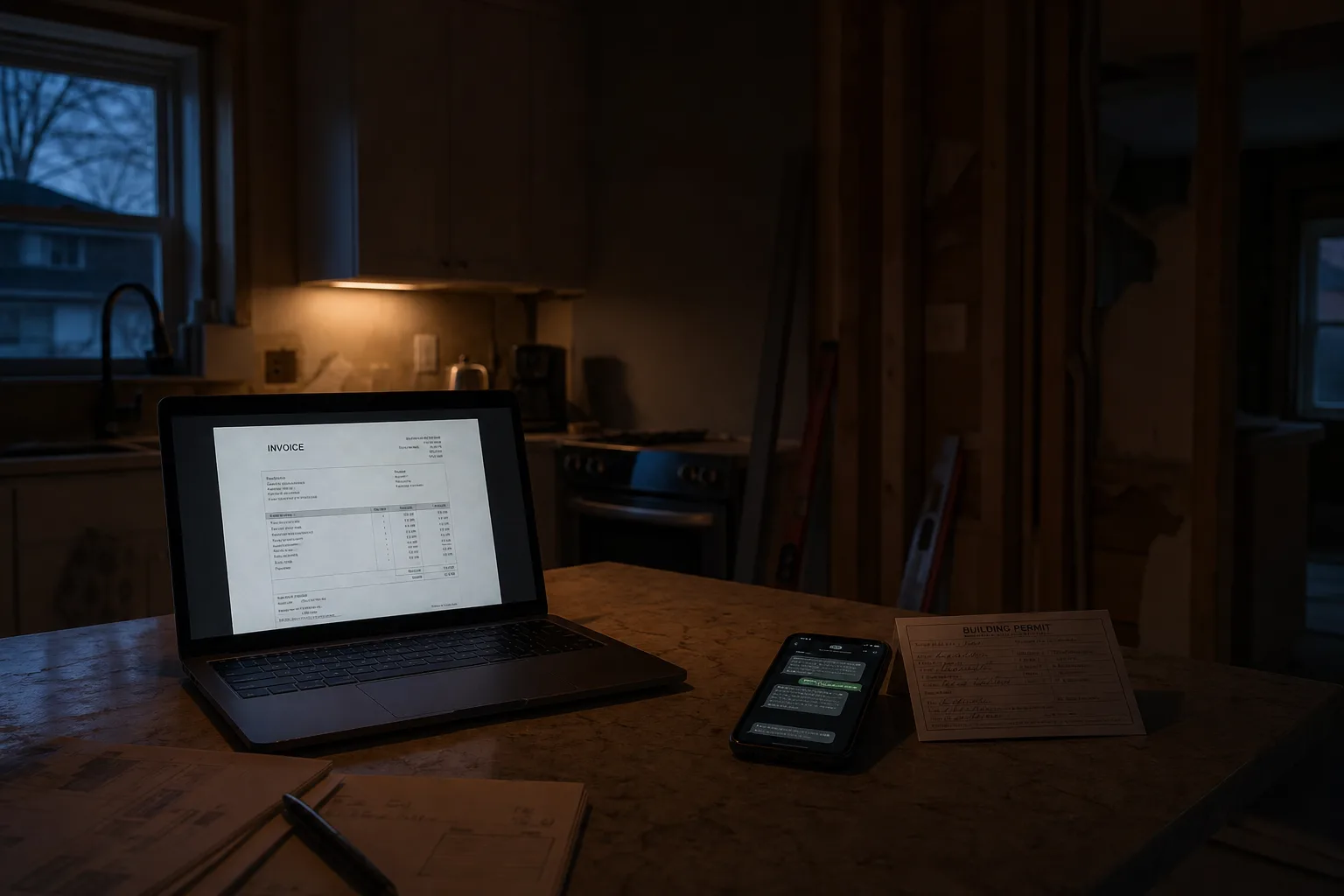
The paperwork on a renovation used to arrive in an envelope. A contract on carbon paper, a permit card taped to a window, canceled checks returned by the bank, a manufacturer's warranty card you mailed back with a stamp. An owner two states away could reconstruct the whole job a decade later from a single accordion folder. That system has quietly come apart in the last several years, not because anyone decided to abandon it, but because each piece of it moved somewhere else, and most of the new places do not keep things.
What actually changed, and why it matters more when you are not there
Three shifts did most of the damage. Payment moved to apps and card readers, so there is no canceled check with a memo line and no bank image showing a signature and a date. Approvals moved to text messages, where a change order worth several thousand dollars looks exactly like a question about paint sheen. And municipal permitting moved to online portals, which display an inspection history beautifully while you have an active account and are silent about how long that record will be retrievable after the job closes. None of these are bad developments. They are simply fast, and speed is what erases trails.
For an owner on site, the loss is partly covered by memory and by the physical evidence of the house. You remember the conversation on the driveway about moving the panel. You saw the inspector's truck. From four hundred miles away, none of that backstop exists, and the record is the only version of the job you will ever have. That is the real difference between a competently documented project and a barely adequate one: not the volume of files, but whether a stranger reading them in six years could tell what was done, by whom, under what authority, and for how much.
The documents that carry a job, and the two that people skip
A complete file is smaller than most people expect. The signed contract with its scope and price. Every change order, written, priced, and accepted before the work happened. The permit number and the closed-out inspection record. Proof of payment tied to each invoice. The warranty documents, both the contractor's labor warranty and the manufacturer's coverage on materials. Photographs of what was behind the walls before they were closed, which cost nothing and become irreplaceable the moment drywall goes up. Six categories. A remote owner can hold all of them without ever standing in the house.
The two that get skipped are lien waivers and the certificate of insurance. A lien waiver is the subcontractor or supplier acknowledging payment, and it is the document that stops a plumber who was never paid by your general contractor from putting a claim against your property months later. Collecting one with each progress payment is ordinary practice in commercial work and unusual in residential work, which is exactly why asking for it separates a job you can defend from one you can only describe. The certificate of insurance should come from the insurer, not forwarded as a screenshot, and it should still be in force on the day work starts.
How long each record stays useful, which is longer than you think
Retention is not one number. Payment records and invoices support what you report on a return, and the Internal Revenue Service is responsible for the federal rules on how long you keep documentation for a filed return. That is the short clock. The long clock is basis. Capital improvements to a property adjust what you paid for it, and that adjustment matters when you sell, which may be twenty years out and may be handled by someone settling your estate rather than by you. Improvement receipts, therefore, are effectively permanent records, and they should be stored where a permanent record belongs rather than in the same folder as a service call from last spring.
Between those two extremes sit the ones with defined lives. A contractor's labor warranty typically runs a year or two and is worthless if you cannot produce the contract that granted it. Manufacturer coverage on a roof or a water heater runs much longer and usually requires the original invoice showing the install date and the installer's name. Then there is your state's limit on construction defect claims, a statute of repose that runs from substantial completion and varies considerably, which is worth checking once for the state your property is in and then treating as the outer boundary for keeping the whole job file intact.
A filing habit that works when you are never in the building
The habit that holds up is capturing at the moment of the transaction rather than at the end of the job. When a change order comes in by text, reply in writing confirming the scope and the price, then move that exchange somewhere durable the same day. Screenshots are acceptable evidence and unacceptable filing, because a photo roll is not searchable and a phone replacement can quietly lose a year of a project. Move it to cloud storage with a name that carries the date, the property, and the subject, in that order, so that files sort themselves without you thinking about it.
Ask the contractor at the outset to send documents to an email address rather than to your phone, and pay by a method that generates a statement rather than one that generates a notification. If a payment app is genuinely the only option, follow it with an emailed receipt request. Download the permit record from the municipal portal when the final inspection closes instead of trusting the portal to still have it. Save the inspector's name. These are five minute actions with a shelf life measured in decades, and they are the actions an absent owner can take that no phone call substitutes for.
What a good closeout looks like from a distance
Ask for the closeout package before the final payment leaves your account, because that is the only moment when you have leverage and the contractor still has the subcontractors' attention. It should contain the final lien waivers, the closed permit, warranty documentation with model and serial numbers, and photographs of concealed work. A contractor who assembles this without argument is telling you something reliable about how the rest of the job was run. A contractor who cannot produce it is telling you something too, and better now than at a closing table years later, when the buyer's attorney asks who pulled the permit.
The file you end up with is the only part of the project that keeps working after everyone goes home.