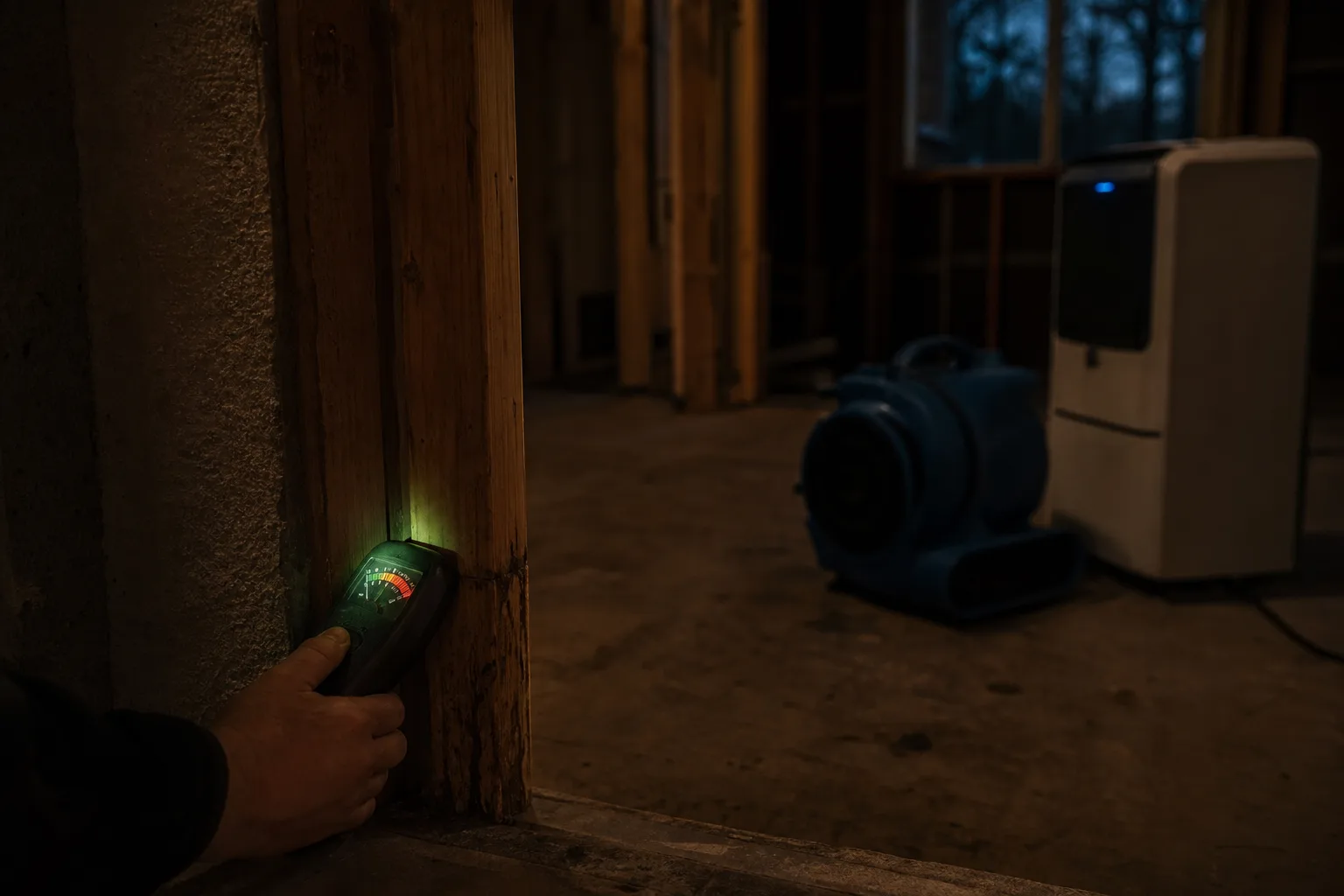
The equipment is rarely the expensive part. Air movers and a dehumidifier or two, running for the better part of a week, land somewhere well under what a single room of replaced flooring costs, and yet the drying line is the one owners try to cut when they are paying out of pocket and watching the number climb. What actually decides the bill is who is standing behind the drying, waiting, and whether their calendars line up with the moisture readings or with the owner's hope. From four hundred miles away, that lineup is the only thing you can really manage.
The technician taking readings, and what a meter reading is worth on the phone
The person running the drying equipment is measuring two things: moisture in the materials and the humidity of the air the equipment is pushing. Materials come down on a curve, fast at first, then slowly, and the last several points take longer than the first twenty. An honest technician will tell you the framing is at a given reading and that it needs to reach a number matched to unaffected material elsewhere in the house. Ask for readings from the same marked locations each day, photographed with the meter in the frame. That single request changes the conversation from opinion to record, and it travels by text.
What you are trying to catch is the difference between surfaces that feel dry and assemblies that are not. Subfloor under vinyl, the bottom plate of a wall, insulation inside a cavity, the underside of a stair tread: these hold water long after a hand finds nothing. Crews who have done hundreds of these jobs know exactly where the slow spots sit in a given construction era, and they will name them before you ask. If nobody can tell you which specific locations are still reading high, the drying has stopped being measured and has started being guessed.
The adjuster, whose file wants dates more than adjectives
Your carrier's adjuster is working a file that needs a cause, a date of loss, a scope, and evidence that the mitigation was reasonable. Adjusters approve drying time that is documented and question drying time that is asserted. The daily readings that keep your technician honest are the same records that keep the mitigation invoice from getting trimmed later, which is why a crew that photographs meters is worth more to you than a crew that is a hundred dollars a day cheaper. Get the adjuster's preferred format early. Most will say plainly what they need.
There is a timing problem here that catches absent owners in particular. The adjuster may want to inspect before demolition, the crew wants to open walls today, and you are on a plane. The workable version is documented permission: photographs of the wet assemblies, a written note from the crew stating what they intend to remove and why, and the adjuster's acknowledgment by email. That exchange usually takes a day or two, sometimes an afternoon, and it protects the invoice at the far end. Skipping it is the most common way a legitimate cost turns into an argument.
The flooring installer and the cabinet shop, who will not start on a promise
The trades who come after drying have their own reasons to wait, and they are not being difficult. Hardwood and engineered flooring manufacturers write moisture limits into their installation instructions, and an installer who lays over a wet slab or subfloor voids the warranty and owns the cupping that follows. A good installer will bring a meter, take his own readings, and decline if the number is wrong. Cabinet shops behave the same way with wall framing. This is the point where drying quickly stops being cheaper, because a second install is a full-price install.
Their lead times are the other half of the arithmetic. Material orders run weeks, not days, and a crew booked for a Tuesday does not sit idle waiting for your subfloor. Miss the slot and the next one may be a month out. So the sequence that saves money is counterintuitive: order materials and hold the installation date while drying is still running, then move the date once, based on a reading, rather than booking optimistically and cancelling. Installers accept one honest reschedule far better than they accept arriving to a job that is not ready.
The hygienist you may not need, and the one call that settles it
If the water sat for days, came from a contaminated source, or the house has occupants with respiratory problems, an independent indoor environmental consultant is the person who ends the debate about whether the space is safe to close up. The Environmental Protection Agency is responsible for federal guidance on mold and indoor air quality in buildings, and its framework is the one most consultants work from. The value to a remote owner is a written clearance from someone with no stake in the reconstruction contract. It typically costs a few hundred dollars and buys a document that a buyer, a tenant, or a carrier will accept later.
On a tight budget, the honest triage is this: skip the consultant on a clean-water loss caught within a day and dried on a documented curve, and pay for one when any of those conditions fail. Scheduling runs a few days out in most metros, and the report follows within a week. Build that into the calendar before the drywall crew is booked rather than after, because reopening a finished wall to satisfy a question you could have answered in week one is the single most expensive way to save money on a drying job.
What cannot be done by phone is the meter placement, and what can be done by phone is everything about sequence. Get the readings photographed, get the adjuster's acknowledgment in writing, hold the installer's date loosely, and decide about the consultant early. Handled in that order, drying properly and drying affordably turn out to be the same job.