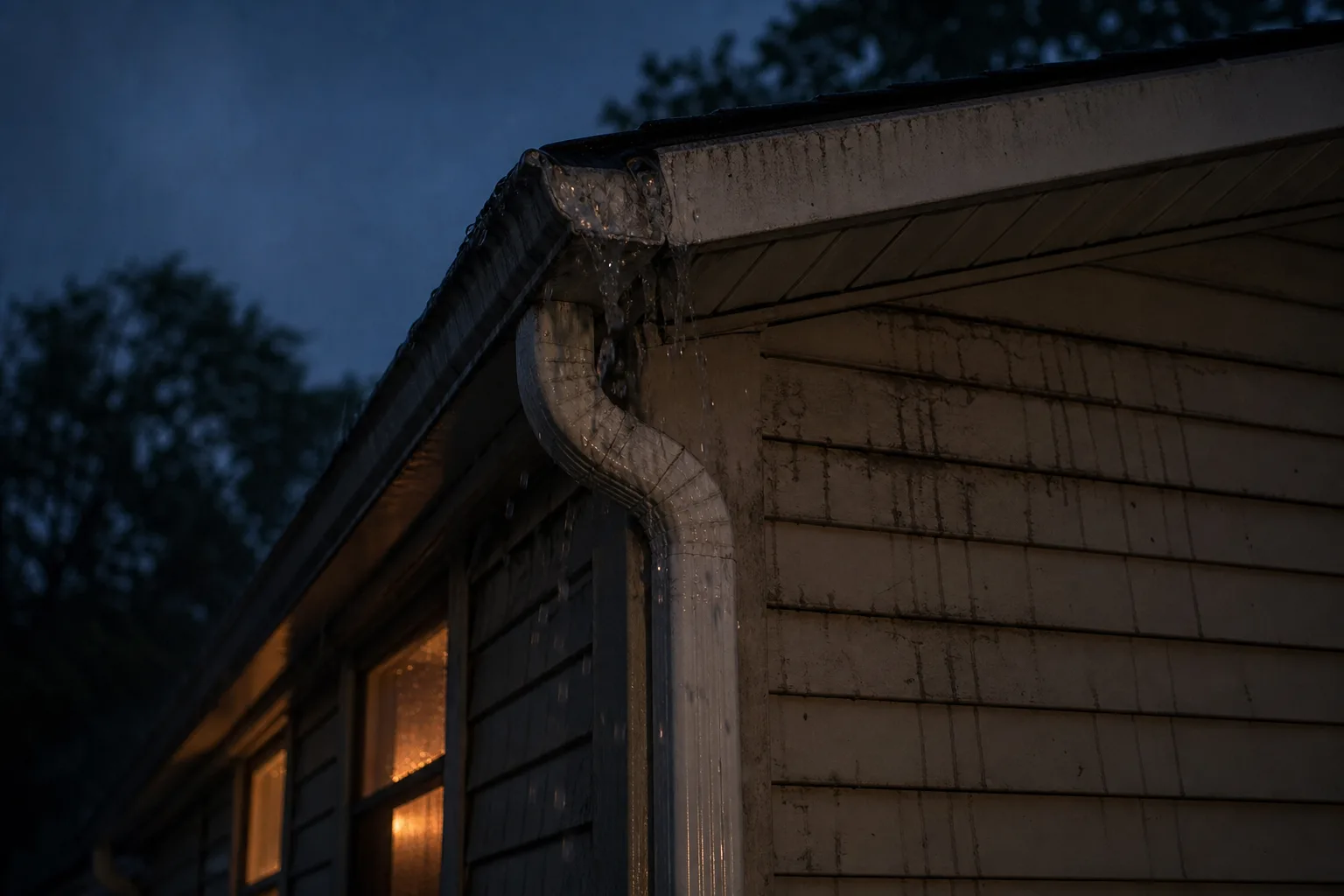
The economics of deferred upkeep are not linear, and anyone managing a property from four hundred miles away learns this on a schedule they did not choose. A clogged gutter is a twenty minute job in September and a soffit replacement in March. What separates those two numbers is not effort or skill but elapsed time, and the amount of elapsed time you can safely spend is set less by the item itself than by where the building stands. Two identical houses, one in Tucson and one outside Portland, will punish the same missed interval at wildly different speeds.
The interval is set by water, and water moves on a regional clock
Almost every compounding maintenance failure in a house is a water story, either liquid water finding an entry or water vapor failing to leave. The Environmental Protection Agency is responsible for guidance on indoor moisture and mold, and the reason its material keeps returning to drying times is that the window between wet and damaged is measured in days, not seasons. A gutter that backs up in a place with sixty inches of annual rain overflows within one storm cycle; the same debris in a dry climate sits inert for a year. Your maintenance interval is really a question about how many wetting events happen between visits.
Freeze-thaw shortens that window further and in a way that is genuinely unforgiving. A hairline crack in a walkway or a foundation parge coat that would sit stable for a decade in the Gulf South will open measurably across a single Upper Midwest winter, because water enters, expands, and widens the void it entered through. The compounding is mechanical and repeats every night the temperature crosses freezing. Owners who set their inspection calendar by the calendar year rather than by the number of freeze cycles consistently arrive one season late, which is the expensive one.
Local ordinances quietly set some of your intervals for you
Beyond climate, municipalities impose upkeep intervals with real financial teeth, and these vary enormously across county lines. Many cities require sidewalks to be cleared of snow within a fixed number of hours after accumulation stops, and they will bill an absent owner for municipal clearing plus an administrative charge, then repeat that for each event. Vegetation ordinances work similarly: grass over a stated height triggers a notice, a cure period, and then contracted mowing at rates no private landscaper would quote. None of these are large individually. They arrive monthly, they attach to the property, and in some jurisdictions an unpaid abatement charge becomes a lien.
Septic is the clearest case of a rule setting your budget. Some counties require documented pumping at a stated interval and require the record to be filed, while a neighboring county requires nothing at all and leaves the schedule to the owner's judgment. In wildfire regions, defensible space clearance around structures is inspected and enforced, which converts brush removal from an aesthetic choice into a compliance date. Coastal and hurricane counties add their own layers around roof condition and opening protection. Before you set a service calendar, read the ordinance, not the general advice.
What distance actually adds to the bill
The absent owner pays three surcharges, and only one of them is obvious. The first is discovery lag: the interval between a failure starting and anyone noticing it, which is your visit frequency or your caretaker's attentiveness, whichever is shorter. The second is mobilization delay, because a vendor you have never met, hired by phone, with nobody on site to open a door, will schedule you behind the customers who can be there Tuesday. The third is scope inflation, which is what happens when the person writing the estimate knows you cannot walk the job and compare what was described to what is there.
Timelines are the honest way to price this. A leak found on a routine visit is usually a same-week repair by a general handyman. The same leak found four months later has typically involved a drywall contractor, a painter, and a moisture reading before anyone will close the wall, which is three trades to sequence and generally three to six weeks from first call to finished surface. If insurance enters, add the adjuster's inspection and the estimate review. Nothing in that sequence is unreasonable. It is simply long, and it starts later for you than for a resident owner.
Building a calendar that matches the jurisdiction
The practical fix is to anchor the schedule to two documents rather than to habit. One is the municipal code section on property maintenance, which tells you the enforced intervals and the cure periods attached to each notice. The other is a written scope with a local person who has keys, ideally a property manager or a trusted contractor on a small retainer, whose job includes photographing the roofline, the grade around the foundation, the water heater pan, and the crawlspace on a fixed cadence. Photographs dated monthly turn discovery lag from months into weeks, which is where most of the savings live.
Set the retainer before you need it, because the useful version of this relationship takes a season to build. Expect the first two or three cycles to produce photographs of things that turn out to be nothing, and expect the fourth to catch something real. That is the arrangement working as designed. The interval you are buying is not the visit. It is the shortened distance between a small failure starting and a competent person standing in front of it with a phone.