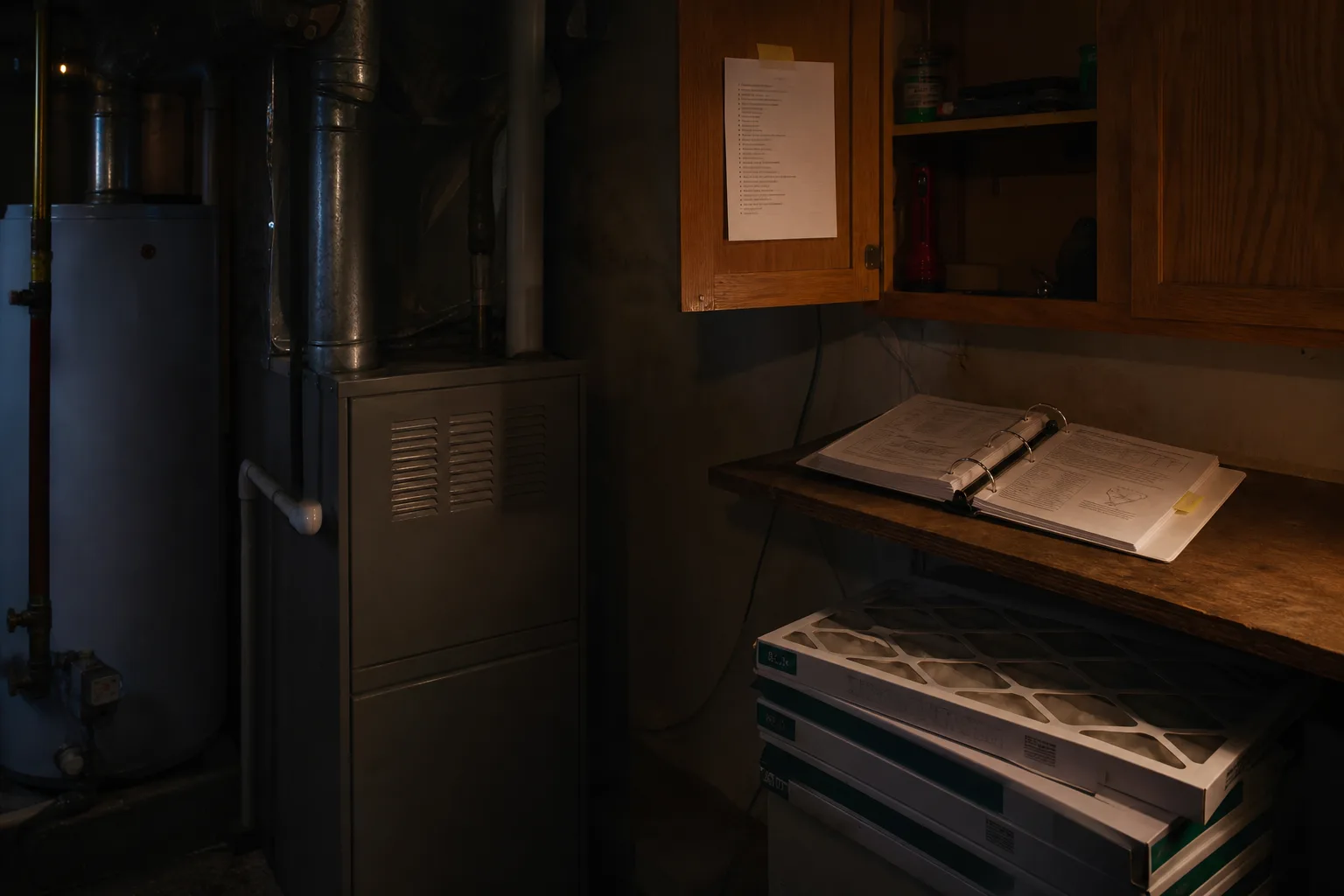
Somewhere around month four in a new house, most people build a maintenance list. It runs to thirty or forty items, it is accurate, and it dies by August. The failure is rarely discipline. It is that the list was built from articles rather than from the house, so it names tasks nobody can start without first going to look at something, measuring it, or finding a model number. A building engineer running two hundred thousand square feet does not work that way, and the reason is worth borrowing.
The inventory comes before the schedule, and it takes one afternoon
A facilities department does not begin with a calendar. It begins with an asset register: every piece of equipment that can fail, listed with make, model, serial number, install date, location, and the part numbers it consumes. Only after that list exists does anyone write intervals against it. For a house, the equivalent is a walk with a phone camera, photographing the data plate on the furnace, the water heater, the air handler, the dishwasher, the disposal, the sump pump, the garage opener, and the electrical panel directory. That walk takes an hour and a half in a modest house, and it is the single highest-value ninety minutes of your first year.
What the inventory changes is the character of every future task. A reminder that says check filter is a research project at nine on a Sunday night. A reminder that says 16x25x1 MERV 8, air handler, hall closet, three in the box on the shelf is a four-minute job you will actually do. Providers learn this the hard way, because a technician dispatched without a part number burns a truck roll. The same economics apply in a house, except you are the truck.
Three systems households actually keep, and where each one breaks
The recurring calendar event is the cheapest option and the most commonly abandoned. It costs nothing, it lives where you already look, and it survives a phone upgrade. Its weakness is that a calendar has no memory of completion: you dismiss the alert, the next instance appears in six months, and nothing anywhere records whether the gutters were cleaned in April or skipped. After two years you cannot answer a buyer's question or an adjuster's question about frequency, and you cannot tell whether a failure was bad luck or neglect.
A home maintenance app sits in the middle. The better ones seed a task list from your home's age, square footage and climate zone, hold photographs and receipts against each system, and keep a completion history you can scroll. The cost is a subscription and a dependency: if the company folds or you stop paying, the history is often awkward to export, so it is worth confirming at signup that you can pull your records out as files. Used with a real inventory behind it, this is the closest a household gets to what a property manager runs.
The paper binder, one tab per system, still outperforms both for certain households. It sits in the utility room where the work happens, it accepts the sticker the technician peels off his clipboard, and nobody has to be logged in. It will not remind you of anything, which means it needs a calendar alongside it, but as a place to put paperwork it has no rival and no renewal date. Plenty of small property companies run exactly this hybrid: reminders on a phone, evidence in a folder.
The work order is the part households leave out
In a commercial building, a preventive maintenance task is not finished when the work is finished. It is finished when someone closes the ticket, notes what was found, and flags anything that should become its own job. That closeout is the whole reason the system holds together over years, because it converts a schedule into a history, and a history is what tells you the water heater has been drained annually since 2019 or that the crawlspace has been dry through four wet springs. Households almost never do this step, and it costs them at exactly the wrong moments.
Copying it is cheap. When you finish a task, photograph the result and let the timestamp do the record keeping, then write one line somewhere permanent: date, what you did, what you noticed. The noticing is the valuable half. A slow rust bloom at a water heater fitting, a gutter seam weeping, a dishwasher hose with a hard kink: none of these is today's job, but all three become next quarter's job only if somebody wrote them down while standing in front of them.
The paperwork that makes the schedule survive year two
Four documents carry most of the weight. Manuals, which almost all manufacturers publish as PDFs searchable by model number, and which state the actual service intervals rather than the internet's generic ones. Warranty registrations, which frequently require you to have registered within a set window after installation and which sometimes hinge on documented annual service. Service invoices from every technician who has been in the house, filed by system rather than by date. And a one-page summary taped inside a utility room cabinet listing filter sizes, breaker locations, the main water shutoff, and the gas shutoff.
That last page is the one a provider would call a site sheet, and it is what any competent facilities operation posts at the mechanical room door. It answers, in ten seconds and without a phone, the questions that otherwise turn a small event into a large one. It also does something quieter: it makes the house legible to a house sitter, a spouse, a contractor, or whoever is standing there when a supply line lets go at seven in the morning. Energy Star, run by the Environmental Protection Agency, is the federal program responsible for benchmarking how buildings perform over time, and the same principle scales down: a building you have documented is a building you can measure.
Phasing it across a first year without losing a weekend
The inventory walk is one afternoon. Downloading manuals against those model numbers is another sitting, maybe an hour, best done at a desk with the photographs in front of you. Setting the calendar or the app from the manuals rather than from memory takes perhaps forty minutes, and this is the step people skip, which is why their schedules ask for things at the wrong intervals. From there the ongoing cost is small: ten minutes to file an invoice after a service call, and one seasonal review, twenty minutes with a cup of coffee, where you read your own notes and decide what becomes a job.
Run that way, the schedule stops being a list of chores you are behind on and becomes a record of a house you know. The distinction matters most in the situations you did not plan for, when an insurer asks how often the roof was inspected, when a buyer's agent asks for service history, or when a technician asks what was done last time and you can answer with a date. Larger organizations pay for software to get that. A household can get most of it with a phone camera and a folder.
The previous owner left you a house and, if you are lucky, a drawer of curling receipts. Turning that into something you can act on is not a project, it is three sittings spread across a first year, and the order matters more than the tools: know what you own, know what it asks for, then write down what you did.