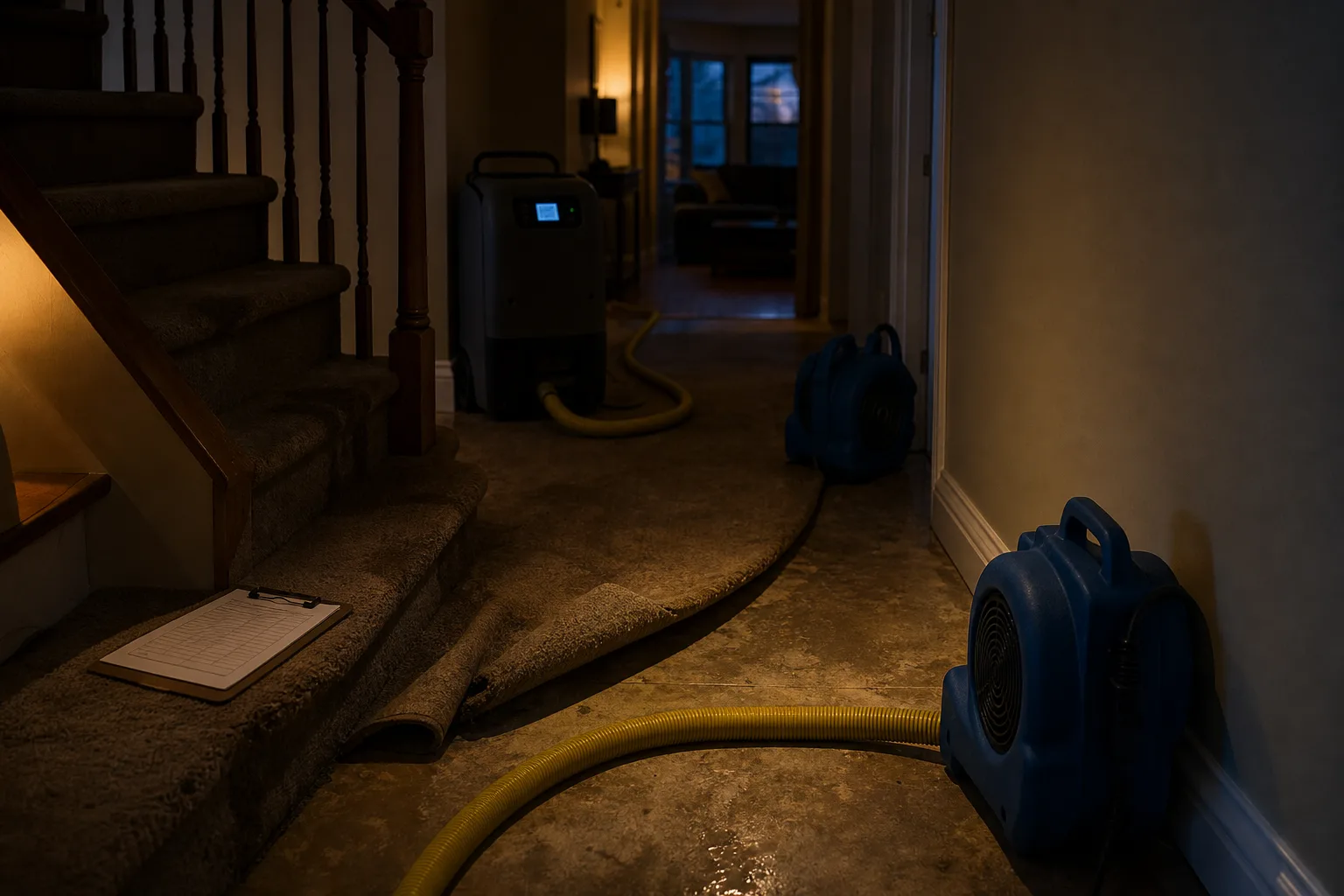
The call goes to a national number, a national brand arrives in the driveway, and the reasonable assumption is that the person unrolling hose into your hallway is an employee of the company whose name is painted on the van. Sometimes that is true. More often, in the first forty-eight hours after a supply line lets go or a storm finds a way in, three separate organizations have already touched your file, and only one of them will be standing in your kitchen. Knowing which is which changes almost nothing about the drying. It changes everything about who fixes a problem.
The dispatch, the franchise, and the crew are usually three different parties
A large restoration provider typically operates as a network of independently owned locations working under a common brand and a common set of operating standards. Above that sits, in many insurance-referred jobs, a third-party administrator, a company the carrier pays to manage vendor assignment, file notes, and scope review. The call you make at one in the morning may be answered by a national answering service, routed to the administrator, and assigned to the nearest participating location, all inside roughly thirty to ninety minutes. The technician who arrives two to four hours later works for that local owner. The scale is what got someone to your door before sunrise.
That structure is not a trick, and it is not hidden. It is the reason a network can staff a two-hour arrival window at three in the morning during a freeze event when every plumber in the county is already booked. The larger organization supplies the equipment inventory, the training standard, the moisture documentation software, and the surge capacity to pull crews in from two states away. What it does not supply is a single employer for every person on site. Ask, in the first hour, which location holds the contract and who owns it, and write the answer down.
What you sign in hour one, and what it does not cover
The first document is almost always a work authorization for emergency services, and it is a narrow instrument. It permits extraction, removal of unsalvageable materials, and placement of drying equipment, usually at rates published in the estimating platform the carrier and the contractor both use. It is not an authorization for reconstruction, it is not a contract for the rebuild, and it frequently includes a direction to pay clause that sends the insurance proceeds for that emergency work straight to the contractor. That last clause is the one worth reading slowly at two in the morning, because it is the piece that survives the week.
Mitigation and reconstruction are separate scopes, separate approvals, and often separate legal entities, even when the same brand handles both. The mitigation invoice tends to land with the carrier within days of equipment pull. The rebuild estimate takes longer, because it waits on the adjuster's scope, and the gap between the two is where homeowners assume work has stalled when in fact the file has moved to a different desk. You are allowed to decline the rebuild and keep the mitigation crew. Say so early, politely, and in writing.
The forty-eight hours that actually carry weight
Extraction happens on arrival. Equipment placement follows within the same visit, and the number of air movers and dehumidifiers is calculated from room volume and material class rather than guessed. Then the house sits, loud and warm, and the meaningful work is invisible: daily moisture readings taken at marked points, logged against a drying goal derived from an unaffected area of the same material. The Environmental Protection Agency is the federal authority on moisture and mold in buildings, and its long-standing position that wet materials need to be dried promptly is the reason the schedule is measured in hours rather than convenience.
Typical drying runs three to five days, sometimes longer for hardwood or plaster, and the crew should return each day to read, adjust, and record. If nobody comes on day two, that is not the process; that is a scheduling failure, and it is the first thing worth escalating. The daily log is also your evidence later, when someone asks why a subfloor was removed. Ask for a copy as it is generated rather than at the end.
Where the escalation actually goes
When something needs putting right, a stained carpet edge, a missed room, a technician who left a door unlocked, the complaint goes to the local owner first, because that is who employs the crew and carries the general liability policy. The national brand can apply pressure and, in a franchised network, has standards it can enforce, but it will route you back to the franchise owner to resolve the substance. If the job came through a third-party administrator, that coordinator is a second lever, since assignment volume is the thing a participating location cares about most. Your adjuster is the third.
Get the owner's name, the coordinator's name, and the claim number inside the first day, while everyone is still friendly and the water is the only problem. Escalations that start with the right name attached move in hours. Escalations addressed to a brand move in weeks.
The scale of a large provider is genuinely what gets equipment into a flooded house overnight, and the layered structure behind it is the price of that reach. Read the authorization, log the names, keep the readings. The drying takes care of itself after that.