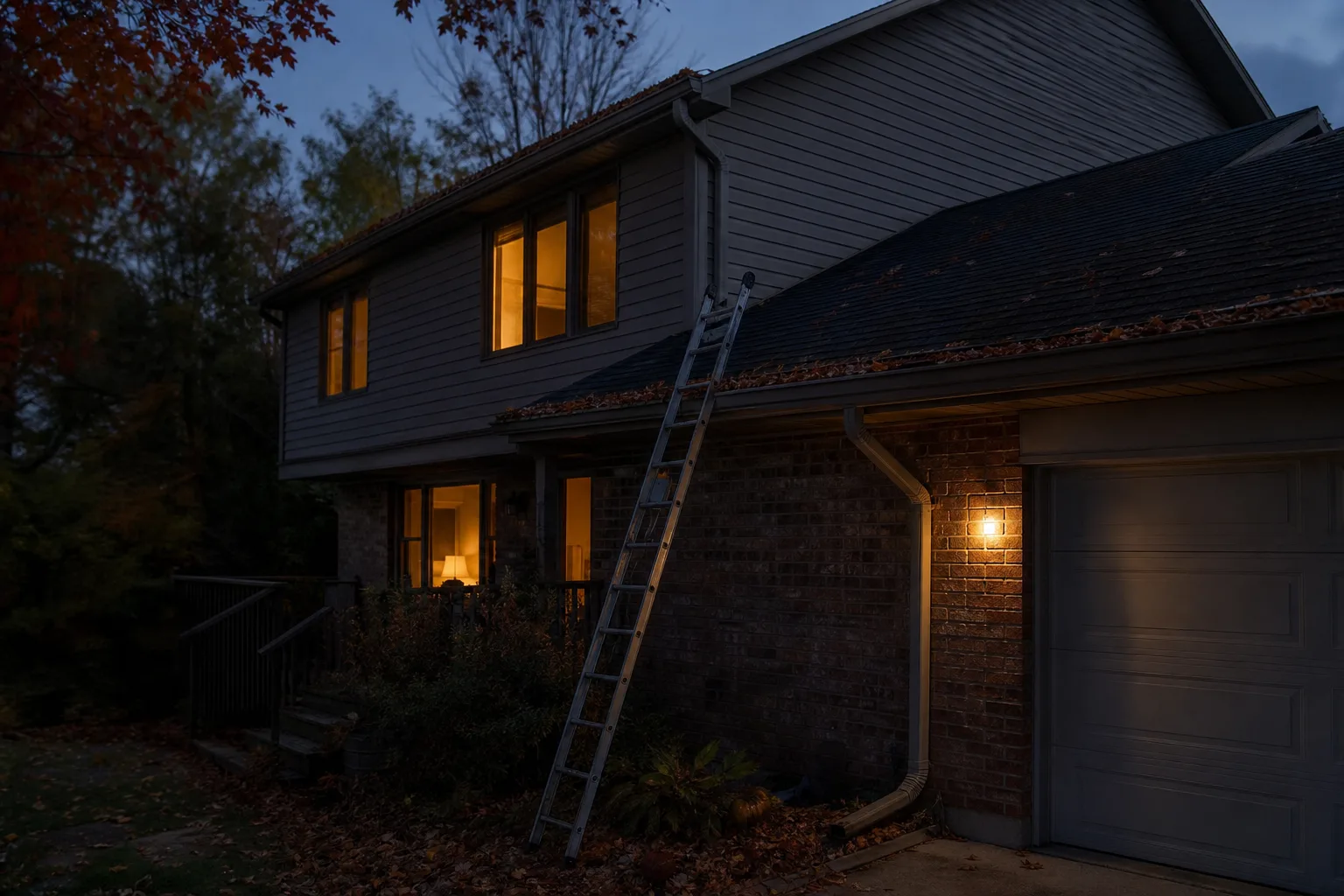
The house was built in 1954, sits on a quarter acre that slopes toward the back, and came with a finished basement the sellers had described as dry. In the first September, the new owner priced out doing the gutters herself: an extension ladder, standoff stabilizers, a set of work gloves, and a Saturday. The math looked obvious. Buy the ladder once, use it twice a year, and the tools pay for themselves inside eighteen months. She called a gutter company anyway, mostly to have a baseline. What the estimator said on the phone reframed the whole question, and the two hours the crew eventually spent on the property were not the part that mattered.
The assumption is that you are buying time. You are usually buying consequence
Nearly every conversation about hiring out household upkeep runs through hours. A Saturday is worth something, the job takes four of them, and the quote either beats that number or it does not. That framing works cleanly for jobs where a bad outcome is a redo: a floor mopped poorly gets mopped again, a mediocre window wash annoys you until the next rain. It falls apart the moment the job puts a person at height, over a hard surface, on a ladder set at the wrong angle on ground that slopes. The Occupational Safety and Health Administration is responsible for fall protection standards on job sites for a reason, and the reason does not stop applying because the ladder belongs to a homeowner.
The second half of the assumption is subtler and costs more. Doing it yourself gets the debris out. It does not get you a person who has looked at four hundred gutter runs that season and can tell you, standing on the rung, which parts of yours are behaving oddly. That observation has no line on the invoice. It is the reason certain jobs sort into the paid column and stay there, and it has almost nothing to do with whether you own a ladder.
What the crew found before the first handful of leaves came out
Two people arrived on a Tuesday morning and walked the perimeter for roughly ten minutes before touching anything. The lead came back around with three things. The rear run, about thirty feet along the low side of the roof, was pitched backward: water was standing at the far end rather than moving toward the downspout, which explained a stripe of dark staining on the fascia the owner had read as ordinary weathering. Two hanger spikes on that same run had walked out far enough to move by hand. And the gutter troughs held a noticeable quantity of asphalt granules, the fine dark grit that sheds off shingles, concentrated below one plane of the roof rather than spread evenly.
None of that is exotic. All of it is invisible from the ground, and two of the three would have been invisible from a ladder to someone who had never been told what to look for. The pitch problem was fixed the same morning by resetting hangers, a change of maybe fifteen minutes of labor folded into the visit. The granule concentration went into a note: not urgent, worth photographing again next fall, useful context whenever the roof conversation arrives. The staining stopped spreading. The basement, which had been damp in one corner after long rains, stayed dry through the winter, which is not proof of anything but is the kind of quiet result these visits produce.
The calendar is the real constraint, and almost nobody plans for it
Here is the part that changes how you should schedule rather than whether you should hire. Gutter companies in areas with deciduous trees have a season, and the season is short. Calls placed in August are typically scheduled within a week or two, sometimes at the customer's choice of morning. Calls placed in late October, after the first heavy leaf drop, land in a queue that can stretch several weeks, and the crews running that queue are working long days with less slack for the walk-around and the conversation that made this visit worth the money. That delay is not somebody failing to return a call. That is demand arriving all at once, and it is predictable enough to work around.
The other calendar fact is that one visit is often the wrong count. On a lot with mature oaks, which drop late and drop twice, a single cleaning in early October gets undone by November. The owner on Bellview booked two from the start: one in the first half of October and one after the trees were bare, usually a few weeks before the ground freezes. Two visits close together cost less per visit than two visits booked separately in a panic, and the second one is when the crew can see the roof edge clearly with nothing on it.
Where the line actually falls between the two columns
The sorting rule that came out of this case is narrower than the usual advice and easier to apply. Pay for anything that requires standing above the height of a single story, anything performed on a roof surface, and anything where the useful product is a report rather than a result. Gutters on a two-story house meet all three. So does a chimney inspection, and so does the annual look at a roof after a serious hail event. Keep the work where the failure mode is simply a worse version of the same job: interior cleaning, filter changes, condensate lines you can reach standing up, the exterior faucets you shut off in the fall, the dryer vent run if it is short and accessible from the floor.
Insurance is the quiet second half of the rule. A licensed and insured crew carries coverage for its own people, which is the thing a homeowner cannot buy for a friend who offered to help hold the ladder. Ask for a certificate before the first visit, not after, and keep it with the house file alongside the invoice and the photographs.
The ladder never got bought. What did get built, over the first year, was a short standing list of the jobs that leave the house with information attached, and a habit of calling for them in August while the phone still gets answered on the first ring.