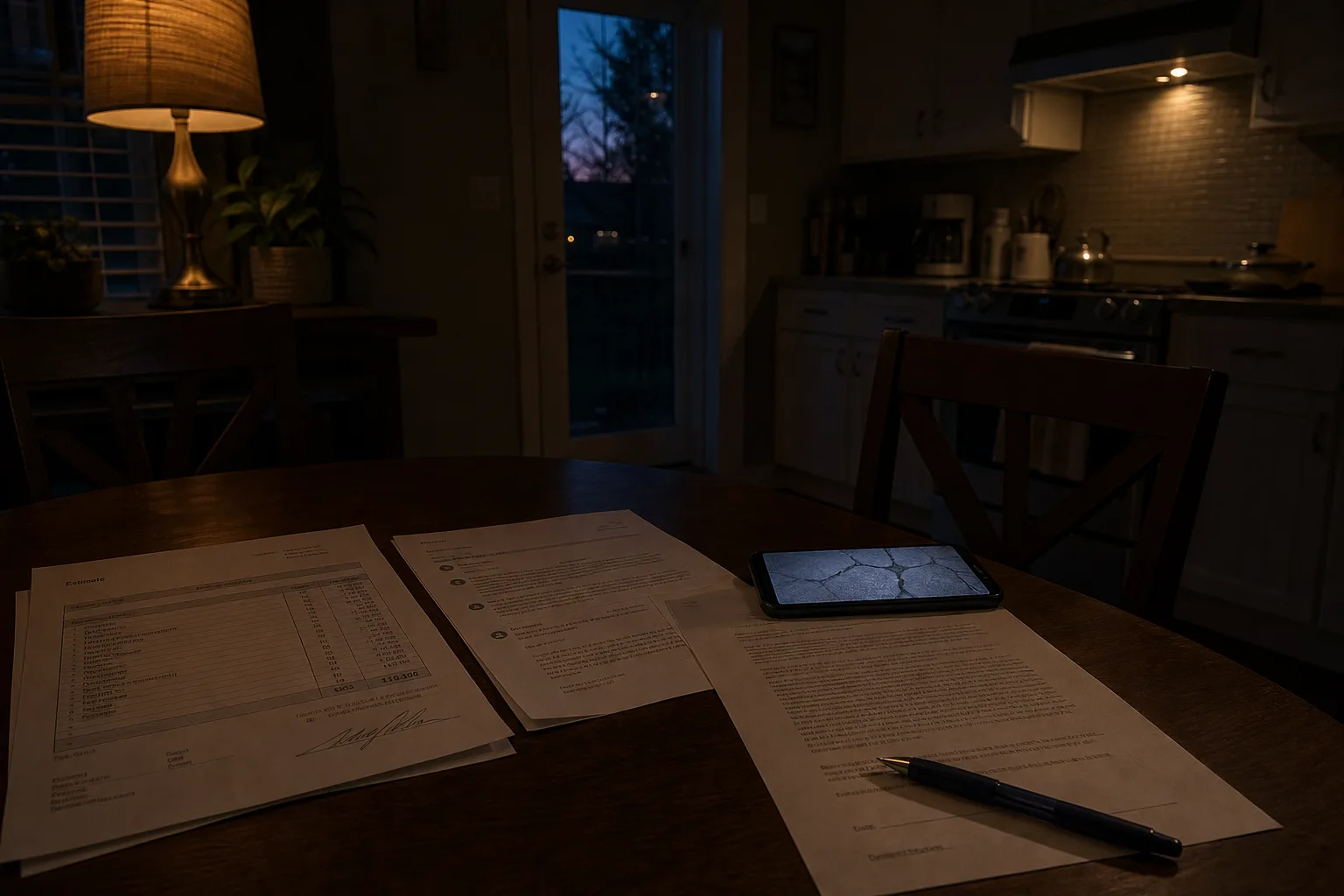
Most people reach their first real dispute carrying an assumption they never examined: that settling is what you do when your position is weak, and that holding out is what you do when you are right. The first year in a house produces a steady supply of these moments. A tile job that lifted in November, a plumber who billed for a part he did not install, a seller who did not mention that the sump pump ran continuously every spring. The assumption is wrong in a specific and expensive way, and the correction matters most to the person who has never done this before.
What is actually true is simpler. Settling is a decision about time and cost, made against a case that is usually neither as strong nor as weak as it feels in the first week. People who have been through it several times settle earlier, not because they are more timid, but because they have watched the arithmetic play out. The question is never whether you are right. It is what being right will cost to prove, how long proving it takes, and what is left on the table after.
The clock starts before you think it does
A dispute has a quiet phase that most first-timers mistake for nothing happening. You send an email. Nothing. You call, get voicemail, and leave a message. Two weeks pass. That stretch is not dead time: it is the first stage of the process, and it typically runs three to six weeks from the first complaint to the point where you know whether the other side intends to engage at all. Treat it as a measured period with an end date rather than an open-ended wait, and write down the date you decide the silence has become an answer.
The second stage, once someone does respond, moves faster than people expect. A contractor who returns a call will usually come look at the work within a week or two, because an unresolved complaint is worse for him than a repair visit. If he offers to fix it, the repair itself is often shorter than the negotiation about whether it was his fault. First-timers frequently spend six weeks establishing blame for a problem that would have taken four hours to correct. That is the characteristic beginner's error, and it is the one worth catching early.
What the next stage actually costs, in months
If informal resolution fails, the paths available are a formal written demand, a complaint to a licensing board or a consumer agency, small claims court, or a lawsuit with an attorney attached. These are not a ladder you climb in order, and the time each one consumes varies enormously. A demand letter resolves or does not resolve inside about thirty days. A licensing board complaint runs on an administrative schedule measured in months, and it is aimed at the contractor's license rather than at your money. Small claims is usually the fastest route to an actual decision, often a couple of months to a hearing date.
A full lawsuit is a different order of commitment. Discovery alone can run longer than the entire renovation that caused the argument, and the hours you spend assembling documents, sitting for depositions and coordinating with counsel are hours you do not bill to anyone. The Federal Trade Commission oversees consumer protection in this territory and maintains complaint channels for it, which is worth knowing when the dispute concerns a sales practice rather than workmanship. For a defective bathroom, though, the practical question is narrower: how many months of your own attention is the disputed amount worth?
Run that number honestly before you decide anything. If the gap between you is twelve hundred dollars and the fight will occupy you across eight months, the settlement that closes it at seven hundred next Tuesday is not a surrender. It is a purchase of eight months. The people who regret settling are usually the ones who did the arithmetic afterward.
Why your evidence is worth more now than later
There is a second clock running, and it works against you. Evidence in home disputes decays in ways that legal evidence in other contexts does not. The failed grout gets cleaned, the water stain dries and fades, the smell goes away, the neighbor who watched the crew work moves to another state. Photographs taken the week the problem appeared are worth considerably more than photographs taken after a winter of ordinary use, because the other side's first argument will be that something else caused it in the interval.
Memory is the other perishable item. Your own recollection of what the estimator said in the driveway in March is sharp in April and soft by September, and the version you eventually write down will have been shaped by everything that happened since. Write the account while it is fresh, date it, and keep it with the photographs, the signed estimate, the change orders and every text message in the thread. This is a two-hour job done once, and it both strengthens a settlement position and makes the decision to settle easier to evaluate.
Reading the offer for what it closes
When a number finally arrives, the number is the least interesting part of it. Read what the payment releases. A settlement that resolves the tile and quietly discharges all claims arising from the entire project is a very different document from one that resolves the tile, and a first-timer reading a one-page release will not always see the difference. Check whether the release covers future problems from the same work, whether it covers the subcontractors as well as the general, and whether it requires you to keep the terms confidential.
Check the timing too. An offer payable in thirty days from a business that has been slow to answer the phone is a promise, not a payment, and the enforcement of a broken settlement is its own small process. Ask for payment on signature where you can. If the resolution is repair work rather than money, write down what will be done, by whom, by what date, and what happens if the date passes. One paid hour with an attorney to read a release before you sign is cheap relative to the amount usually in play, and it is the single best place a first-timer can spend money in this whole sequence.
The signals that say hold
Some situations genuinely reward waiting, and they share features worth recognizing. Hold when the full extent of the damage is still unknown, because an offer made before the drywall comes down is an offer priced on optimism. Hold when the other side has an insurer involved and the adjuster has not completed an inspection, since the number improves once the file is documented. Hold when you are inside a statutory window that gives you leverage and the deadline is still comfortably distant. Outside those conditions, the earlier settlement is usually the better one, and knowing which you are in is most of the skill.
The first dispute teaches a habit that serves every one after it: decide in advance what outcome you actually need, write the figure down, and measure every offer against it rather than against how the last phone call made you feel.