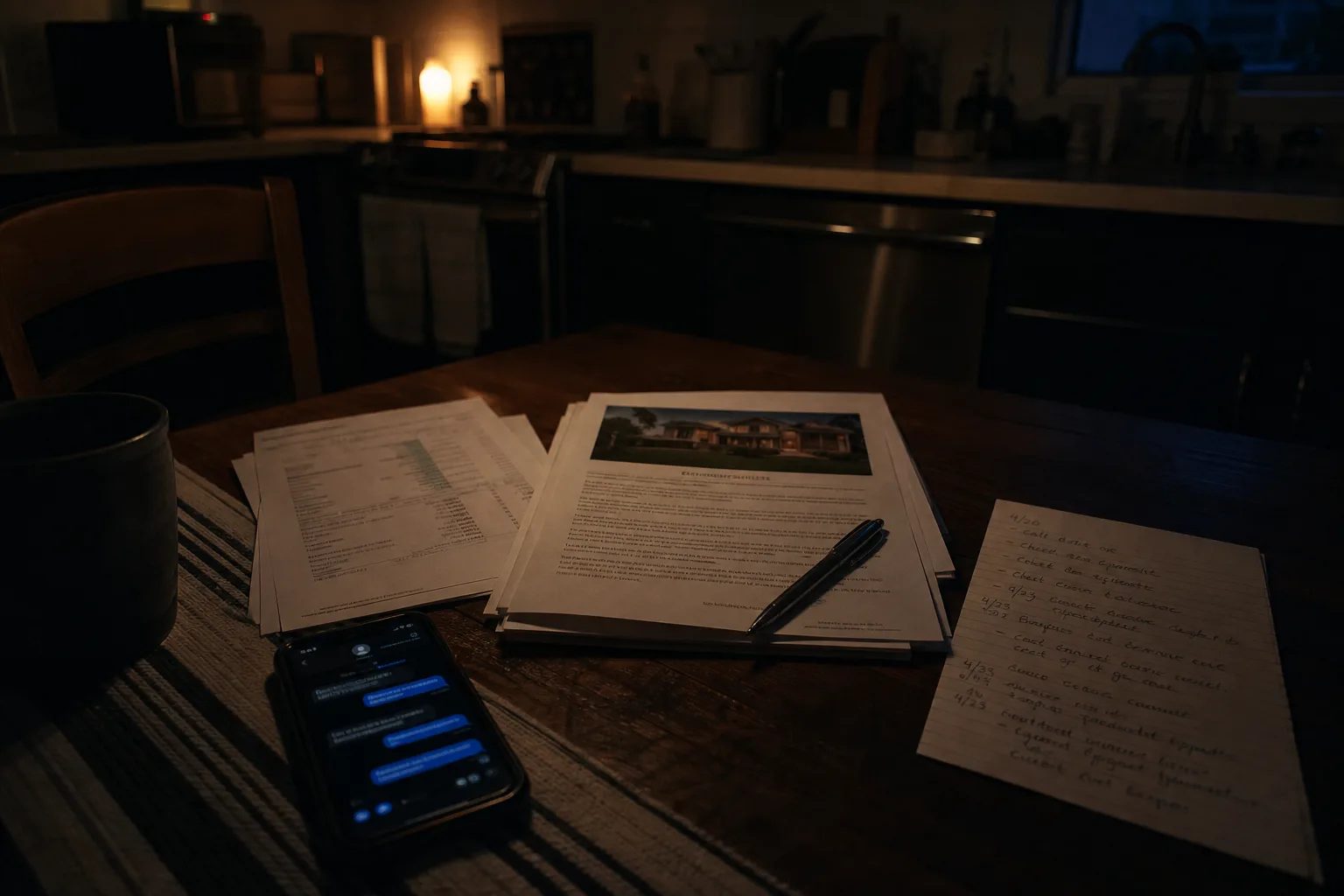
The stain in the kitchen ceiling appeared in February, and the first meeting with an attorney happened in June. Almost everything that determined what that meeting cost had already happened in the four months between, in phone calls nobody billed for and text threads nobody was saving on purpose. The owner did not know she was building a file. She was just trying to get the leak stopped. By the time she sat down across a desk, the difference between a one-hour consultation and a five-hour reconstruction was already settled, and it had been settled by housekeeping.
The four months when nothing seemed to happen
The pattern of those weeks is worth describing precisely, because it is the pattern almost everyone reports. She called the general contractor, who said he would send the plumber. The plumber came ten days later, ran water for twenty minutes, said the pan was fine and the problem was probably grout. The tile setter came the following week, at the general contractor's arrangement, and said the pan was not fine. Then three weeks passed with no callback at all. She left two voicemails and sent one email, and that email, sent at nine on a Tuesday night, later turned out to be the most valuable document in the file.
What she did in that period cost her nothing in fees and a great deal in evenings. She photographed the ceiling each time it darkened and left the photographs on her phone, where the dates stayed attached to them. She kept replying to the general contractor's texts rather than switching to phone calls, partly out of frustration and partly because she wanted a record. She saved the original contract, the two change orders, and the payment receipts in one folder in a kitchen drawer. None of this felt like preparation. It felt like chasing people.
Who the man in the bathroom actually worked for
The first substantive question the attorney asked was not about the leak. It was about who employed the plumber. The owner had signed one contract, with the general contractor, for the whole remodel. The plumber had never sent her an invoice, never asked her for a check, and had introduced himself in her hallway as though he worked for the company on the contract. He did not. He worked for himself, under a subcontract with the general contractor, and that single fact reorganized the entire matter: her contractual claim ran against the general contractor alone, while any direct claim against the plumber would have to be built on a different theory entirely.
Number of parties is the most reliable driver of legal cost in a construction dispute, and it is set by the subcontract structure rather than by the size of the damage. Each additional entity means another conflict check, another entity search, another certificate of insurance to chase, another letter, and another set of responses to read. The Federal Trade Commission oversees unfair and deceptive practices in consumer transactions, and home improvement work sits squarely in that territory, but the question of who owes you a duty is answered first by the paperwork and only then by any consumer statute. Knowing the structure before the meeting is what keeps the meeting short.
What the folder cost to build
She spent three evenings and one Saturday morning on assembly, which is the honest figure and roughly what this takes for a job of that size. The first evening was the contract, the change orders, and the two proposals she had solicited but not accepted. The second was the bank record, downloaded as a statement rather than retyped, showing four payments and their dates. The third was the text thread, exported rather than screenshotted, because a screenshot loses the timestamps that make a thread useful. The Saturday morning was the part that mattered most: a single page, in date order, of what happened and who said it.
That one page is the difference between an attorney reading a matter and an attorney excavating one. Reading a clean chronology takes a few minutes. Building the same chronology from a shoebox, a phone, and a client's memory takes hours, and those hours are billed at the rate of whoever does them, which may be a paralegal if the firm is set up that way and the attorney if it is not. Most firms bill in six-minute increments, so the granularity is real. Every call the firm has to make to a plumber's office that does not answer lands on the invoice.
The meter in the room
The consultation itself was a flat fee, credited against the engagement if she retained the firm, which is one of several common arrangements; others are a free initial call of fixed length, or straight hourly from the first minute. What the hour bought was not a legal opinion about who caused the leak. It bought four things: the identity of every party with potential exposure, the deadline that actually governed her, a written description of the next step, and a scope-limited engagement covering a demand letter rather than a lawsuit. The deadline turned out to be a state notice requirement with a right-to-cure period, and it was closer than the general limitations period she had been quietly assuming.
Ask what drives the number and the answer is consistent across firms: how many parties, whether the key facts exist in writing or have to be proved through testimony, how close the nearest deadline is, and what remedy you say you want. The last one is the largest and the one clients control most directly. A letter that sets out a defect, a date, and a demand is a contained piece of work. Litigation is an open-ended one. Saying which you are buying, at the first meeting, prevents the engagement from drifting into the more expensive version by default.
What the second meeting looked like
The follow-up ran shorter than the first, which is the tell that the preparation worked. She brought the plumber's business entity name, pulled from the state registry in about ten minutes at her kitchen table, and the certificate of insurance the general contractor had produced when she asked for it in writing. The demand letter went out the following week, addressed to the general contractor as the party she had contracted with, with the plumber's insurer copied. The general contractor's response arrived eighteen days later and proposed an inspection, which is a slow answer but an answer, and inspections are how these matters get resolved.
The economics of the whole episode come out clearly. She spent something under five hours of her own time on assembly, spread across four days she would otherwise have spent watching television, and bought an hour of an attorney's attention that did not have to be spent on archaeology. Had she arrived with the same facts in her head and nothing on paper, the identical advice would have taken three or four times as long to produce, because the firm would have been reconstructing, at its rate, what she could reconstruct at hers.
The leak was fixed in August, by a different plumber, paid for under the settlement. The file, now four inches thick and organized by date, sits in the same kitchen drawer where it started.