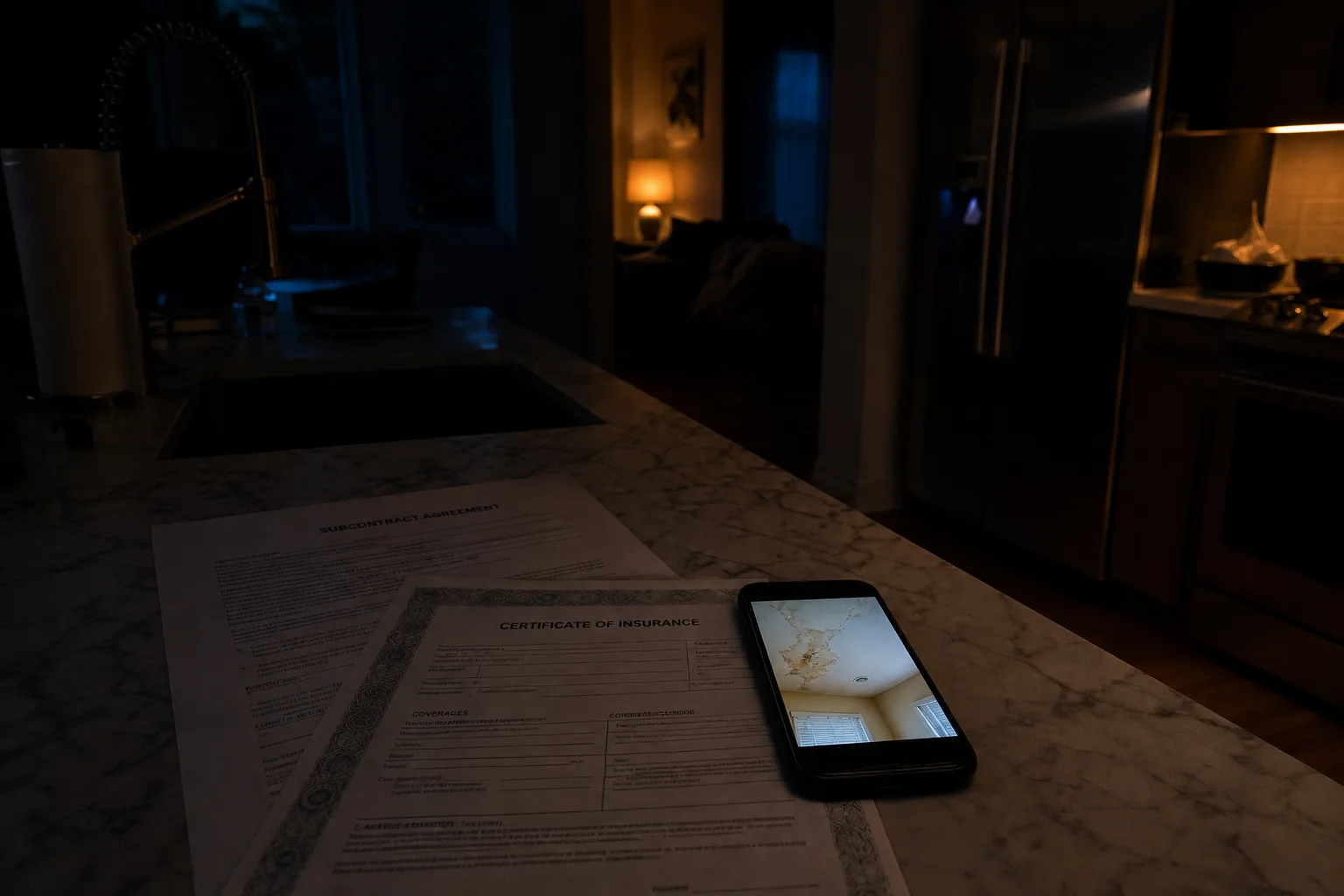
The remodel was a second-floor bathroom, finished in April, signed off without a punch list argument, paid in full. The stain on the kitchen ceiling below showed up the following March, eleven months later, first as a ring the size of a coaster and then, over about six weeks, as a soft patch that a fingertip went into. The repair meant opening the ceiling, pulling the new tile, and rebuilding the pan. The dispute that followed ran fourteen months. What settled it was not the leak, which everyone agreed on within a week, but which records could be shown to be what they claimed to be.
The tile setter was never the homeowner's contractor
The homeowner had a contract with a general contractor. The general contractor had a subcontract with a tile company, and the tile company sent two men, one of whom was on that company's payroll and one of whom was not. The waterproofing membrane under the pan was installed by whichever of them was there that Tuesday. That distinction decided everything downstream, because the homeowner's remedy ran only to the general contractor, the general contractor's remedy ran to the tile company, and the tile company's insurer wanted to know, in writing, who its insured had actually put in the room.
The first three weeks went the way these usually go. The homeowner called, the general contractor sent someone to look, and the someone agreed the pan had failed. Then the calls stopped being returned, which is the point where a complaint either becomes a file or evaporates. The homeowner started a file. Her contractor's carrier opened a claim in about ten days once she wrote instead of called, and the tile company's carrier took closer to ninety days to acknowledge tender, which is ordinary and not a sign of bad faith, though it feels like one.
The same claim, assembled ten years ago
Run that dispute in 2015 and the folder is mostly paper. Photographs printed at a drugstore, undated unless the homeowner wrote on the back. A handwritten log of calls, which is worth something but only as a memory aid to the person who wrote it. A change order signed on a clipboard in a truck, with one copy in the homeowner's kitchen drawer and one that the contractor could not locate. Phone records showing that a call happened, never what was said. Everything turned on a person sitting in a chair and testifying that yes, this is a fair and accurate depiction of the pan on that day.
That system worked, slowly. Getting a records custodian to authenticate a business record meant a deposition or a live witness, and scheduling one across three parties and two carriers added months to a case that was already measured in seasons. The evidence that held up was the evidence somebody could swear to from personal knowledge, and the evidence that failed was hearsay dressed as certainty: what the neighbor remembered, what the salesman promised, what everyone agreed had probably been said.
What changed, and when
The structural change arrived with the 2017 amendments to the Federal Rules of Evidence, which added Rules 902(13) and 902(14) and allowed electronic records generated by a system, and data copied from an electronic device, to be self-authenticated by a written certification from a qualified person, provided the other side gets advance notice and a chance to object. State courts have adopted parallel provisions on their own timetables since, which is why the answer to whether your phone dump needs a live witness now depends on which courthouse you are in. The practical effect is that machine-generated records stopped requiring a human escort.
The second change is newer and pulls the other way. Advisory committees and trial judges have spent recent cycles on the authenticity of generated and altered images, and the working assumption behind a photograph has quietly shifted. Ten years ago a picture was presumed real until someone gave a reason to doubt it. Now the question of how the image was produced, and whether the file offered is the original or a copy of a copy, gets asked early. Originals with intact metadata have gained weight. Screenshots, which strip almost everything, have lost it.
What decided this file
Three things carried. Her own phone photographs, exported as original files rather than screenshotted or sent through a messaging app that recompresses and strips embedded data, put the ceiling stain on specific dates across the six weeks it spread. The general contractor's own project management app held the daily schedule entries and the crew assignments, and those entries named the tile company on the day the pan was floated. And the change order for the shower niche, signed electronically, carried an audit trail with timestamps, so nobody argued about when the scope changed.
Three things did nothing. A screenshot of a text thread with the phone number cropped out, which proved a conversation existed with somebody. A verbal assurance about a warranty, given in a driveway. And a neighbor's recollection about which truck was parked where, offered in good faith and worth nothing against a dated dispatch record. The case mediated at month fourteen, the general contractor's carrier funded the ceiling and the rebuild, and the tile company's carrier contributed on the workmanship, largely because the subcontract chain was documented and the dispatch records were not seriously contestable.
What to keep, in what form, from the first week
Photograph on your own device and keep the originals somewhere you control, because the copy that travels through a group chat is not the copy that helps you. Ask at signing for the names of the subcontractors and a current certificate of insurance for each, and keep them, since a year later you will be trying to reconstruct who employed a man you knew only by first name. If the job runs through a contractor's app, export your own thread before the project closes, because that account belongs to the contractor and access can be switched off the week after final payment. The Federal Trade Commission oversees consumer protection in home improvement sales, and written records are what make any of that reachable.
The homeowner spent perhaps two hours total on documentation across the life of the job, most of it in the first week of trouble. That two hours is what moved the file from a disagreement between recollections to a claim two carriers could evaluate without anyone taking a deposition.