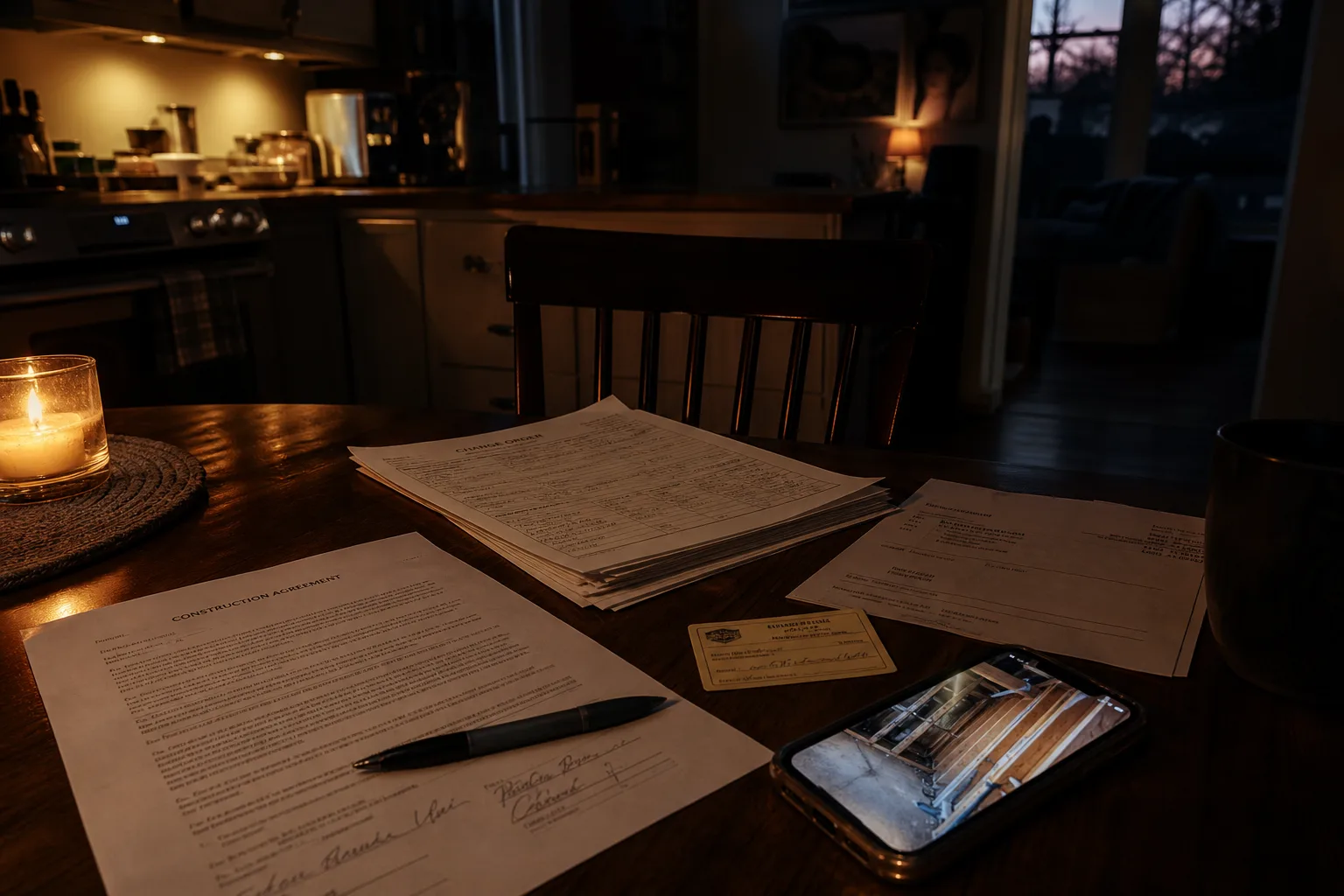
The first time most homeowners assemble evidence, they photograph everything and write nothing down. It is the natural instinct, and it produces a file that looks substantial and settles almost nothing, because a photograph proves a condition existed on the day the shutter fired and stops there. It does not say who agreed to what, which company employed the person holding the trowel, or whether anyone was told before the tile went down. That second category of proof is what decides disputes now, and it got that way gradually, through a series of changes in how residential work is actually organized.
The file used to be a punch list and a canceled check
For a long stretch, a residential job was documented lightly on purpose. A general contractor quoted a price, the homeowner paid deposits, and the record consisted of a proposal on letterhead, a handful of checks, and a walkthrough list scribbled near the end. Disputes were argued from memory and from the physical evidence in the house, and the person who had been on site every day was usually the same person whose name was on the contract. That last part is what has changed most. The record did not need to trace responsibility, because responsibility sat in one place.
Two shifts pulled it apart. Trade specialization broke a single crew into a dozen separate businesses, each with its own insurance, its own license, and its own idea of where its scope stopped. And residential contracts absorbed language from commercial construction, where written notice, approved change orders, and formal claim procedures had been standard for decades. A homeowner signing a nine-page agreement today is signing a document descended from that commercial lineage, whether or not anyone at the kitchen table explained it that way.
Who the person on site actually works for
Follow the subcontract and the evidence question answers itself. You hired a general contractor. The general contractor subcontracted the framing, the plumbing, the electrical, the drywall, and probably the tile, and one or two of those subcontractors hired a smaller outfit or a labor broker beneath them. The man who told you the shower pan was fine may have been three companies removed from the entity you can actually pursue. His reassurance is not a promise your contract recognizes, and his apology is not an admission by anyone who owes you money.
This is why first-time complainants so often arrive with a folder full of statements from people whose statements do not bind. What holds up instead is anything traceable to the party in privity with you: the general contractor's project manager, the office that sends the invoices, the person whose signature is on the agreement. When a subcontractor tells you something material, the useful move is not to record it but to relay it upward in writing the same day, asking the general contractor to confirm or correct. That converts a hallway conversation into a document with a date and a recipient.
The same logic runs through payment. A check written directly to a subcontractor, at anyone's suggestion, quietly rearranges who owes you a duty and who can still file a lien against your property. Keep the money flowing along the same path as the contract, and the paper trail keeps matching the legal one.
What the phone changed, and what it did not
Phones made contemporaneous evidence effortless and, in doing so, made its absence conspicuous. A photograph now carries a timestamp and often a location, which means a dated image of an open wall is genuinely persuasive about sequence: the shutoff was installed after the inspection, the flashing was never there, the subfloor was already stained on the ninth. Adjusters, licensing boards, and attorneys have all adjusted their expectations upward accordingly. Nobody is impressed by volume. Forty photographs of finished surfaces are worth less than four taken while the assembly was still open.
Text messages did more. They turned the informal channel of the job into a written record nobody was consciously creating, which cuts both ways. Approval of an extra by thumbs-up emoji has been treated as approval. So has a homeowner's cheerful "go ahead" to a change that later triples the bill. The habit worth forming on a first project is to move anything involving money, scope, or a deadline into email, then screenshot the texts that matter, because phones are replaced, threads are lost, and a group chat that included two subcontractors is not a document you control.
What the phone did not change is the need for a spine. A thousand images with no narrative is not a file. A short dated log, written the same evening, naming who was on site, what was said, and what was decided, holds together everything else. It takes four minutes a day and it is the single most valuable thing a first-timer can start on day one of a project rather than week three of a fight.
The documents that were built to be evidence
Some paperwork exists specifically so a dispute can be resolved without a trial, and first-time homeowners tend to treat all of it as administrative friction. The change order is the clearest example. Its whole function is to record that a change to scope, price, and schedule was proposed, priced, and accepted before the work happened. Signed change orders make a billing dispute short. Their absence makes it long, because both sides then argue about a conversation. A contractor who issues them consistently is not being bureaucratic; he is building the record that protects both of you.
The certificate of insurance matters for the same reason, and it needs to name the right entity. A general contractor's certificate says nothing about the roofing subcontractor's coverage, and a certificate issued eight months ago says nothing about coverage today. Permits and inspection records are the third pillar, because a municipal inspector's sign-off, or the conspicuous lack of a permit that should have been pulled, is third-party evidence that neither party manufactured. Preliminary lien notices belong in the same folder: they tell you which companies actually worked on your house, which is often more than you knew.
Then there is the contract's own dispute machinery, usually a clause requiring written notice within a stated period, sometimes a mediation step, frequently arbitration. Read it in the first week, not the eleventh. The notice clock is the part that surprises people, because it can start running from the date you discovered the problem, and a complaint filed carefully but late arrives already weakened.
What a first complaint file looks like when it holds
Expect the timeline to be longer than the frustration wants. A written notice to the general contractor typically deserves a couple of weeks for a substantive reply, and a reply that proposes a site visit is progress rather than delay. A state licensing board complaint runs on its own schedule, generally measured in months, and it will move faster if the submission is thin and organized rather than thick and chronological. Insurance and warranty claims run in parallel and answer to different documents. None of these are quick, and the waiting inside them is mostly the process working.
The file that holds is small. The contract with the dispute clause flagged, the signed change orders, the invoices and proof of payment showing money moved along the contract path, the dated log, the handful of photographs taken while things were open, the permit and inspection record, and the email thread in which you raised the issue and named a remedy. Statements from people who do not work for your counterparty go in an appendix, if anywhere. The Federal Trade Commission oversees consumer protection in home improvement transactions, and the practices it looks to are the ones that leave a written trail on both sides.
Start the log before there is anything to log. That is the one thing experienced owners do differently, and it costs nothing.