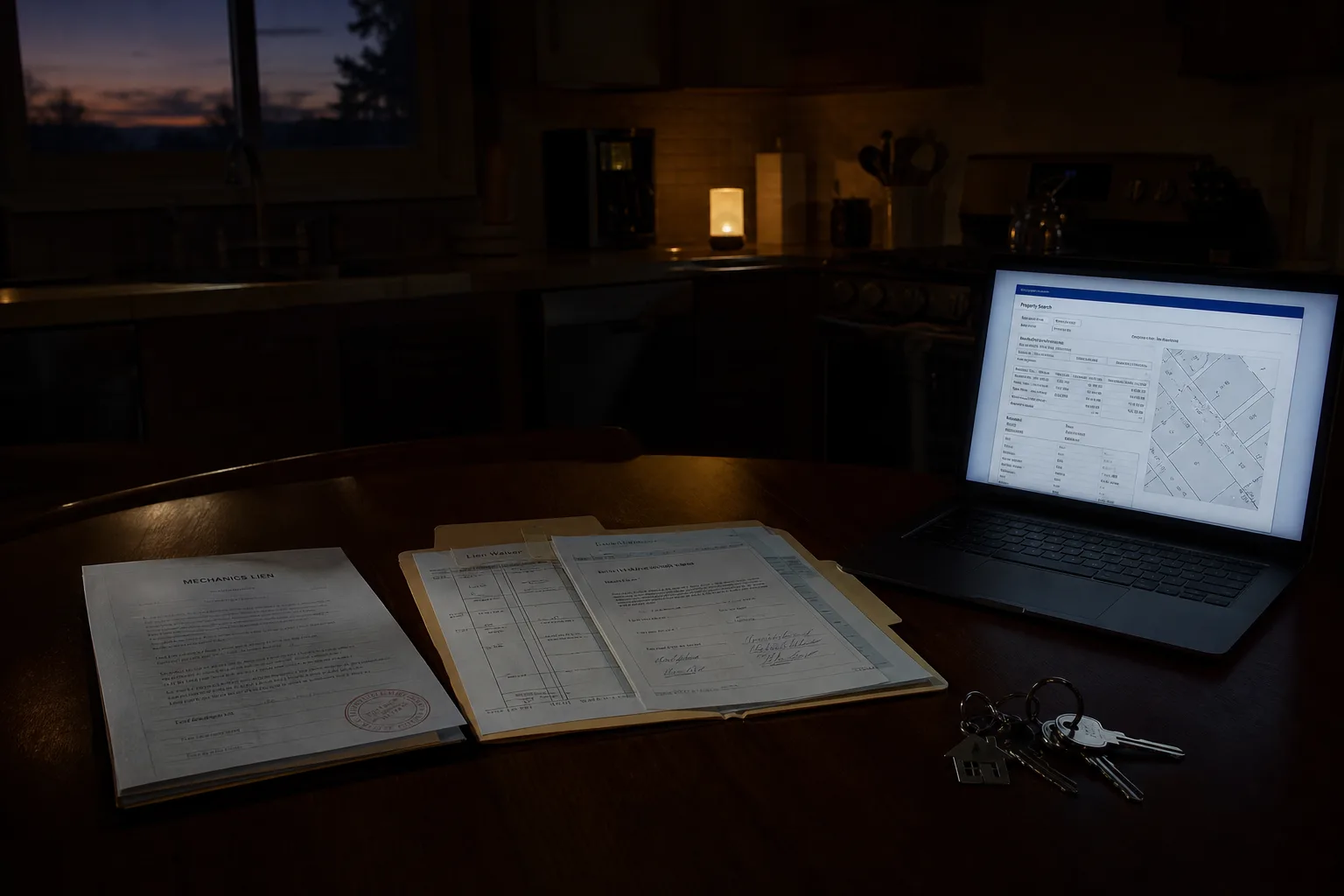
The homeowners in this case, a composite built from a pattern that repeats in every state with a mechanics lien statute, did not find out about their problem from the contractor, the subcontractor, or the mail. They found out from a title company, eleven months after the final walkthrough, in the middle of a refinance that was supposed to close in three weeks. A tile setter they had met twice, whose name they could not immediately recall, had recorded a lien against their house for the value of his portion of the bathroom. They had paid the general contractor every dollar, on time, by check.
That gap, between paying the person you hired and owing the person who actually did the work, is where most homeowners first discover that the contract they signed was not the only contract governing their job. The general contractor had a signed agreement with them. The tile setter had a separate agreement with the general contractor, and no agreement with them at all. He had never been paid out of the draw that covered his scope. Under the law of their state, that failure attached to the house rather than to the company that caused it.
Who the person on site actually worked for
Four trades came through that bathroom: demolition, a plumber, a tile setter, and an electrician who was there for a single afternoon. The homeowners assumed all four were employees of the remodeling company whose truck was in the driveway. Two were. The plumber was a licensed independent holding his own insurance, and the tile setter worked as a one-man sub who took work from three general contractors in rotation. Nobody explained the distinction because nobody had reason to. It matters only when money stops moving, and then it decides everything about who you are dealing with.
The practical test is not whose shirt someone is wearing. It is who issues the check, who carries the insurance for that scope, and who signs the waiver when a draw is released. A homeowner can ask all three questions at the pre-construction meeting and get usable answers in under five minutes. Very few ask, because the answer has no visible consequence while the job is going well. The consequence surfaces later, usually attached to a transaction that has nothing to do with the bathroom.
The consequence nobody traces back to the remodel
A recorded lien does not come with a knock on the door or a demand for payment. It sits in the county records, and it does its work by sitting there. Title companies find it. The refinance in this case did not fail, exactly: it stalled, the lender issued a title exception, the rate lock expired, and the homeowners were told they could proceed only if the amount in dispute was held in escrow until the cloud cleared. That is the shape of the real cost. Not a lawsuit, but a transaction that slows to the speed of a document nobody read.
The same mechanism catches people selling a house, taking out a home equity line, or settling an estate, and in each case the discovery arrives with a deadline already running. The delay that follows splits cleanly into two kinds. Some of it is the process itself, because a release has to be prepared, signed, notarized, and recorded, and the recorder's office works at the pace it works. Some of it is a subcontractor not returning a call, which is not process at all, and which an attorney's letterhead frequently shortens from weeks to days.
What a letter fixed and what it could not
The first two moves cost nothing and required no lawyer. The homeowners pulled their file and found that the general contractor had signed conditional waivers at each draw but had never returned the unconditional waivers that were supposed to follow the cleared checks. That paperwork gap was the entire dispute in miniature. Then they called the tile setter directly, reached him on the second try, and learned he was owed for one scope on one job and had recorded the lien because a collections service told him it was the only leverage he had left.
What needed counsel was narrower and more technical. Whether the lien was valid at all depended on whether the tile setter had served the preliminary notice his state requires within the window measured from the day he first furnished labor, and on whether he had recorded within the statutory period after the job's completion. Those are not questions a homeowner can answer by reading the statute once. One paid hour with a construction attorney established that the notice had been served late, which turned a negotiation about money into a negotiation about whether the lien survived.
Why the same facts produce different answers across state lines
Mechanics lien law is state law, and the variation is not cosmetic. Some states limit an owner's exposure to the amount still unpaid to the general contractor, which means a homeowner who has paid in full and holds the waivers is largely out of reach. Others allow what is often called a full price lien, under which the subcontractor can reach the property for the value of work performed regardless of what the owner already paid upstream. Those two rules produce opposite outcomes from identical facts, and a neighbor's reassuring story from a prior state is worth nothing.
The notice regimes differ just as sharply. Several states require a subcontractor to serve the owner early in the job, which is why that unfamiliar certified letter in week two is worth opening and filing rather than discarding. A few require the owner or lender to record a notice of commencement before work begins, and failing to do it changes the deadlines that follow. Residential projects often carry protections commercial ones do not, including shorter recording windows and mandatory right-to-cure periods that give a contractor a defined chance to fix defective work before anyone files anything.
Local practice layers on top of state law. Counties differ in how quickly a release is indexed, which matters when a closing date is fixed, and in whether releases can be submitted electronically or must arrive on paper with original signatures. Some states let a homeowner bond around a lien, substituting a surety bond for the property so a sale can close while the underlying dispute continues separately. That single procedural option, available in some places and not others, is frequently the difference between a two-week delay and a canceled closing, and it is the first thing worth asking an attorney about.
The line that held up in this case
The homeowners paid for roughly three hours of legal time in total. The attorney sent one letter setting out the late notice, prepared the release for signature, and confirmed with the title company what the lender would accept to remove the exception. The tile setter signed, having been paid directly by the homeowners, who then deducted the same amount from a final punch list payment still owed to the general contractor under a provision their contract already contained. The refinance closed at a slightly worse rate than the original lock.
The Federal Trade Commission oversees unfair and deceptive practices in consumer transactions, including residential home improvement sales, and its rules sit alongside the state licensing and lien statutes that govern the rest of a remodel. None of that reaches down to the question of which plumber was an employee. That question belongs to the homeowner, asked once, early, and answered on paper: who is on site, who pays them, and what document proves they were paid. Collect unconditional waivers at every draw, and the lien problem does not reach the stage where a lawyer is useful.