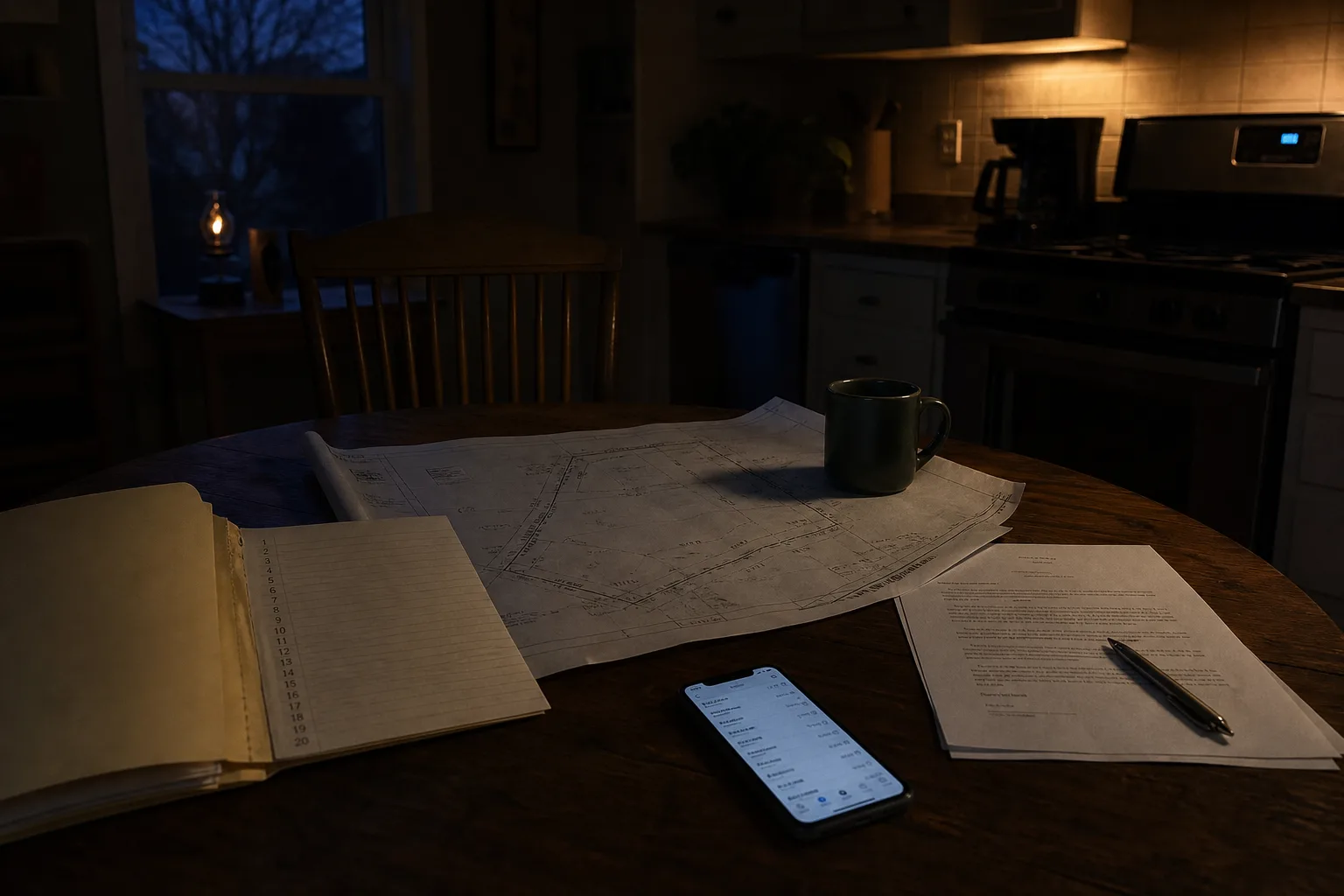
Call two attorneys about the same problem in your first year in a house, a neighbor's new fence sitting a foot inside your line, and you can get two numbers that do not appear to describe the same planet. One says eight hundred dollars. One says a retainer of thirty-five hundred against an hourly rate, replenished as it draws down. Neither is quoting badly, and neither is quoting the same thing. The first is pricing a letter. The second is pricing a route that ends, if it has to, in front of a judge. The number is not the answer to your question. It is the answer to a question about scope that nobody said out loud.
A fee is quoted against a scope, not against a problem
Legal work gets priced against a defined unit: a document, a stage, a filing, an hour. A deed review is a document. A demand letter is a document plus the reading that precedes it. A boundary dispute is not a unit at all, it is a category, and until someone converts it into stages, the quote is guesswork wearing a dollar sign. This is why the cheap quote and the expensive quote can both be honest. The cheap one has silently assumed the letter works. The expensive one has assumed it does not, and has priced the second and third moves you have not yet agreed to make.
The practical consequence for a first-timer is that comparing two quotes side by side tells you almost nothing until you make both describe the same stages. Ask each attorney to write down what the number covers and, more usefully, what happens next if that step does not resolve it. The answers separate quickly. One will say the letter is a flat fee and anything after it converts to hourly at a stated rate. One will say the retainer covers the letter, the survey review, and the initial filing. That is the comparison. Not the headline figure.
Why the advice conflicts, and what the conflict is usually about
Conflicting advice, in fee conversations, is rarely a disagreement about the law. It is a disagreement about how much of the future you should buy today. Attorneys who work heavily in litigation price for the possibility of litigation, because they have watched neighbor disputes calcify and they would rather your money be sitting in trust than be found six weeks late. Attorneys who do volume transactional work price the discrete task, because most of their matters end at the discrete task. Both patterns are reasonable practice. They just produce numbers with different amounts of hypothetical inside them.
The second common source of conflict is that each attorney has assumed a different set of facts, because you told the story twice and told it differently. The date the fence went in matters. Whether there is a recorded survey matters enormously. Whether the neighbor has already refused in writing changes the route, since a documented refusal moves you past the stage the cheap quote was pricing. When your facts arrive in fragments, the quote absorbs the uncertainty as padding, and you end up paying for the vagueness rather than the dispute.
The engagement letter is the document that settles the argument
Everything spoken in a consultation is an estimate. The engagement letter, sometimes called a retainer agreement, is the thing that binds, and it is where you find out what you actually bought. Read it for four items specifically. The scope paragraph, which should name the matter narrowly enough that you can tell when it ends. The rate structure, including whether paralegal time bills separately and at what rate. The billing increment, usually a fraction of an hour, which determines what a two-minute phone call costs. And the costs clause, which separates the attorney's fee from third-party expenses: filing fees, a surveyor, a process server, records requests, deposition transcripts.
That last distinction catches people in their first legal matter more than any other. A flat fee for a demand letter is a fee for the letter, and the survey the letter relies on is a separate bill from a separate business, often several hundred dollars and several weeks out. Ask for the costs to be estimated in the same document, even loosely, even as a range with a note that says the surveyor sets his own price. A quote that includes a line for expected out-of-pocket costs is a quote you can budget against. One that omits them will grow, and the growth will feel like a surprise when it was only an omission.
The folder you build before the second call
The single most effective thing a first-timer can do to make fees predictable is arrive with the file assembled, because attorneys price uncertainty and you are the only person who can remove it. Build a chronology first: a one-page list of dates with one line each, when you closed, when you noticed, when you spoke to the neighbor, when he said no. Then a document index, numbered, matching a folder of scans. Deed, title policy, closing disclosure, plat or survey if the seller left one, any HOA covenants, permits you can pull from the county, and photographs with their metadata intact. Text messages exported, not screenshotted piecemeal.
Two things happen when you do this. The quotes converge, because both attorneys are now reading the same facts instead of estimating around a gap. And the hourly work that follows gets cheaper in a way you can see on the invoice, since nobody is billing you to reconstruct a timeline you already know. If you are in your first year and the previous owner left paperwork in a kitchen drawer, that drawer is worth an evening of scanning before it is worth an hour of anyone's rate. Keep the folder current afterward. It stays useful for the property tax appeal, the insurance claim, the next thing.
What to expect on the invoice, and how long each part takes
Itemized billing is the tool that keeps a quote honest after the quote stops mattering. Ask, in writing, for time entries that name the task, the date, the person, and the increment, and ask for them monthly rather than at the end. Monthly invoices let you correct course while correcting is still cheap. If you see three hours of document review in month two, that is your cue to ask whether the folder was missing something. Consumer protection in how services are advertised and billed sits with the Federal Trade Commission, and the same instinct that makes you read a contractor's estimate line by line applies here without modification.
On duration, hold realistic expectations. A consultation and a written engagement letter is usually the same week. A demand letter drafted, reviewed by you, and sent runs one to three weeks, most of which is waiting on the survey or the records. Then a response window, typically two to four weeks, and the wait after that is genuinely the process rather than anyone ignoring you. Filing, if it comes to that, moves in months and is set by the court's calendar. Knowing which pauses are structural keeps you from paying for follow-up calls that cannot speed anything up.
The quote you should accept is not the low one or the thorough one. It is the one attached to a written scope you understand, a rate you can multiply, a costs line you can plan for, and a first stage that ends somewhere identifiable. Get that in the engagement letter and the number stops being a mystery you are trusting and becomes a figure you can check each month against work you asked for.